It was first mentioned in the spiritual charter of Grand Duke Ivan II of 1356 (1359?). According to some scien...
 Guide license
Galkin swamps by Nikola Lanivets. Nature and art of Ugra - a 7-hour excursion from Kaluga. Our trip combines pristine na …
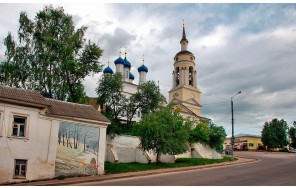
It was first mentioned in the spiritual charter of Grand Duke Ivan II of 1356 (1359?). According to some scientists, it existed even before the invasion of Batu. Originally belonged to Chernihiv governors, from the 14th century. as part of the possessions of Ryazan princes. In 1382, under the agreement of the Grand Duke of Moscow Dmitry Donskoy with the Ryazan Prince Oleg entered the Moscow Principality. In 1386 it was given to Serpukhov prince Vladimir Andreevich Hrabrom and until 1453 was the center of an independent specific Principality of Serpukhov-Borov.
It is referred to as Borovesk, later Borovsk. The name from the ancient Russian boron "pine forest; forest".
15th century. Borovsk becomes one of the links of the defensive ring of the Vokurg of Moscow.
In 1444 near Borovsk was founded Borovsky Pafnutiev monastery. According to the total number of land, farmsteads in other cities and serfs by the end of the 17th century Borovsky Pafnutiev Monastery was among the 20 largest and richest monasteries in Russia. The famous icon painter of the 15th-16th centuries Dionysius worked here.
In troubled times in the monastery Dmitry Pozharsky gathered troops to protect Smolensk and Moscow. In 1610, the voivode Prince Mikhail Volkonsky 10 days defended the monastery from the troops of Hetman L. Sapega and False Dmitry II, was taken because of treason. About 12 thousand people died in the battle, the monastery was burned.
In the Borovsky Pafnutevsky monastery twice (in 1666 and 1667) was imprisoned ideologist of the Old Believers Protopop Avvakum, in the Borovsk prison in 1673-75 were kept in prison boyar F.P. Morozova and her sister Princess E.P. Urusova. Both died in Borovsk, tombstones - in the local history museum.
From the second half of the 17th century, commercial and craft Borovsk became one of the centers of Russian Old Believers. Until 1917, 70% of the population of Borovsk were Old Believers.
In 1708 it was assigned to the Moscow province. In 1777, Borovsk became a district city of the Kaluga governorship.
Early 19th century. Borovsk was a large industrial and commercial center, the second largest (after Kaluga) - 6600 people.
During the Patriotic War in October 1812 Borovsk and the monastery were ravaged by the French (of 800 houses remained 120), but rebuilt anew. Near the city, in the village of Gorodnya, Napoleon decided to retreat along the ruined Smolensk road.
With the construction of the Moscow-Kyiv railway through Balabanovo in the early 20th century, the economic importance of the city faded. In the 1920s. Borovsk for some time lost the status of the district center, becoming part of the Maloyaroslavetsky district. Since 1944 in the Kaluga region.
During the Great Patriotic War of 1941-45 it was occupied by the fascists from October 15, 1941 to January 4, 1942.
The old part of the city is located on a high and flat place on the right bank of the Protva River. Regular planning was provided for by the general plan of the city of 1779. On the rectangular square there were shopping rows (partially preserved), Presence places (late 18th century, rebuilt) and the city Annunciation Cathedral (rebuilt in the 18th century, the bell tower - 1819). From the square, the streets diverged in a rectangular grid, in the construction of which in 18-19 stone merchant mansions began to prevail, located mainly on Moskovskaya Street. Among the public buildings is a two-story women's almshouse (1848).
In the silhouette of Borovsk, temples of the era of classicism played a significant role, including the Church of the Transfiguration on Vzgorje (at the western edge of the central square). The appearance of the outskirts and the nearest surroundings of the city was determined by the Church of Boris and Gleb (1704), the wooden Church of the Intercession in the village of High (late 17 - early 18 centuries), the Vvedenskaya Church in the village of Uvarovskoye (1702), the Church of the Nativity of the Virgin in the cemetery in the village of Groshcha (1708).
3 km south-east of Borovsk, on the left low bank of Protva, in the village of Groshcha, there is Borovsk Pafnutiev (originally Christmas) monastery. Part of the walls of the fortress and the Round Tower were built in the late 16th century, before the Polish-Lithuanian invasion. Later, the Entrance, Georgievskaya and Armory towers (author - stonemason T. Sharutin) were erected in the middle of the 17th century. - Watchdog and Tainitskaya, late 19th century. The Holy Gate is the main entrance to the monastery. Inside the fortress is the monumental five-domed Cathedral of the Nativity of the Virgin (1590-96, interior paintings of 1644), refectory with the adjacent Church of the Nativity of Christ (1511). The main building of the monastery was formed in the 17-18 centuries. Residential and outbuildings are located along the walls: the cell building, hospital wards with the adjacent church of Ilya (1670), the abbot's chamber with the church of Mitrophan (1760-63), the hotel. In the former sub-monastery Rabushenskaya settlement (1 km from the monastery) - the church of Dmitry Solunsky (1804).
Create a query and local guides will offer you the best options