



 Fedyushina Anna Vladimirovna
Suzdal is a city in the Russian Federation, one of the cities of the Golden Ring of Russia, the center of Russ...

A walking tour of the historic core of the city with a guide includes: The Suzdal Kremlin. The Assumption Church.The Cathedral of …

Excursion to the tallest building in Suzdal - St. Bell Tower in the Rizopolozhensky Monastery (72 meters). Inside the bell tower t …

Master classes are held in the current Nikolsk temple on Lebedev Street. It is in this temple that the existing icon painting work …

The village of Sanino is located 20 kilometers east of Suzdal on the banks of the small river Uechka. In this village is St. Nicho …

We make a sightseeing tour of the "Pearl of the Golden Ring of Russia" - ancient Suzdal, and then go to the village of Bogolyubovo …

The master class is held in the center of Suzdal within walking distance from the Kremlin. It's usually a street. Kremlin or Varga …

Visit the observation deck of the city with the history of Russia.Walk to the princely courts of Vladimir Monomakh and Yuri Dolgor …
I offer individual sightseeing walking tours around Suzdal and the historical center of Vladimir, a car and walking tour …
 Guide license
Individual excursions to the cities of Vladimir, Suzdal, Bogolyubovo. Excursions for families, work with groups. Both su …
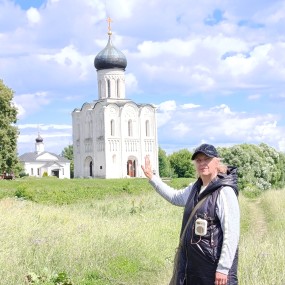 Guide license
Sightseeing tour of chronicle Vladimir.Excursion to the ancient Bogolyubov, with the unique Church of the Intercession.S …
It'll hurt you, It'll be sad or The heart will sink in the rain, - You know what? Let's go to Suzdal! You'll see, we'll …
 Guide license
There is accreditation of Vladimiro Suzdal Museum of the Reserve for selected museum expositions of Suzdal and Kideksha. …
 Guide license
You can walk together in Vladimir, Bogolyubovo, Suzdal, Murom and Yuriev-Polish. The route includes all the most famous …

Day 1. Suzdal, Suzdal Kremlin, Theotokos-Christmas Cathedral, Mead Tasting andDeparture at 07-15 from the East Station (Moscow) to …

Golden Ring of Russia: excursion bus tour Suzdal - Kideksha - Vladimir - Bogolyubovo with the theatrical program "Knight's Tournam …

Vladimir land is the cultural, political, state core of our Fatherland. Vladimir is an ancient political and administrative center …

Day 1.Suzdal, drowning in silence, as if from a fairy tale, ancient as time, and eternal as beauty+ majestic Suzdal Kremlin + Our …

2 days/1 night Unfading classic of domestic tourism. The classic weekend route along the Golden Ring of Russia since 1993. 1 …

2 days/1 night Unfading classic of domestic tourism. The classic weekend route along the Golden Ring of Russia since 1993. 2 da …

Suzdal - Vladimir - Yuzha - Holui - Paleh - Borok - Svyatoyezersky Monastery - Nizhny Novgorod - Balakhna - Yurievets - Kineshma - …
Suzdal is a city in the Russian Federation, one of the cities of the Golden Ring of Russia, the center of Russian tourism, is included in the Vladimir-Suzdal Historical, Artistic and Architectural Museum-Reserve.
Suzdal is a district center in the Vladimir Region, located in the Vladimir Opole, on the Kamenka River (a tributary of the Nerl River flowing into Klyazma), 28 km southeast of the Gavrilov Posad railway station, 35 km north of Vladimir.
The population is 9,286 (2021).

For the first time Suzdal is mentioned in 1024 in the Laurentian chronicle. The city arose on the site of the oldest trade, craft and agricultural settlement. In the 12th century, under Yuri Dolgoruk, Suzdal became such a city of the Rostov-Suzdal principality. Since the 13th century - the capital of an independent Suzdal principality. In 1238 the city was ravaged and burned by the Tatar-Mongols. In the first half of the 14th century, the city became the capital of the Suzdal-Nizhny Novgorod principality. In 1392 it was subordinated to Moscow and gradually became one of the religious centers in Russia.
Since the 16th century, monasteries have been built in Suzdal, old monasteries are expanding, and new ones are being built. Since 1796, Suzdal is a district city of the Vladimir province.
Since the second half of the 19th century, Suzdal is a purely provincial city, which saved it from restructuring.

The center of Suzdal is the Kremlin, from the structures of which the eastern moat and the encircling shaft have been preserved. The monument to the architectural history of Suzdal is the Christmas Cathedral. The white stone church was built in 1222-1225 under Prince Yuri Vsevolodovich on the site of the dilapidated Assumption Church. The cathedral was rebuilt several times, including in 1530 and 1750.
The Golden Gates of the southern and western portals have been preserved to this day - the rarest monument of ancient Russian applied art. Near the cathedral is a complex of bishops' chambers (15-18 centuries). Opposite the southern facade of the cathedral in 1635, a bell tower was built.
In the western part of the Suzdal Kremlin is a wooden St. Nicholas Church, built in 1766, and transported from the village of Glotova Yuriev-Polish district. Around the ancient center of Suzdal, monasteries-fortresses were built, from which to our time have survived: Rizopolozhensky (13-18 centuries), Alexandrovsky (13-17 centuries), Pokrovsky (14-18 centuries), Spaso-Eufimiev (14-18 centuries) monasteries.
Among the Suzdal monasteries of the pre-Mongol period, the Rizopolozhensky monastery, founded in 1207 near the Kremlin, is interesting. The entire ensemble of the monastery is not preserved. The cathedral (1520) is a model of a columnless temple. In 1688, during perestroika, the ancient temple was surrounded by a gallery created by masters Gryaznov, Mamin and Shmakov. The same masters built the Holy Gate. The high bell tower of the monastery was erected in 1813-1819 under the leadership of Suzdal Kuzmin.

Above the Kamenka River is the Alexander Monastery, founded by Prince Alexander Nevsky, in 1240. The present temple of Ascension and the bell tower were built in 1695 at the expense of Queen Natalia Kirillovna Naryshkina (the mother of Peter I).
The most interesting architectural ensembles of Suzdal include the Pokrovsky Monastery, founded in 1364 under the Suzdal Prince Dmitry Konstantinovich. The monastery was one of the largest in Russia of the 16-17 centuries, when disgraced queens, princesses and other women of noble origin were exiled here. From the buildings of the monastery preserved the Holy Gate with the gate of the Annunciation Church (1518).
The central monument of the ensemble is the Pokrovsky Cathedral (1510-1518), surrounded on four sides by an open gallery. The cathedral is connected by a cathedral porch with a tent bell tower (16-17 centuries). To the north of the Pokrovsky Cathedral is the building of the Zachatev Refectory Church (1551). The refectory is adjacent to the original belfry built in the 16th century. The fences and towers of the monastery were built in the 16-17 centuries. Under the building of the Pokrovsky Cathedral there is a tomb where women from the most noble families of Moscow Russia are buried: Alexandra - the daughter of Ivan III, Solomonia Saburova - the wife of Vasily III, Anna Vasilchikova - the wife of Ivan IV, Evpraxia Pozharskaya.
On the northern outskirts of Suzdal, on the precipitous shore of Kamenka, stands the Savior-Eufimius monastery, founded by the Suzdal-Nizhny Novgorod princes in the middle of the 14th century. The best architectural structures of the monastery include the walls lined with pink-red bricks. Richly decorated with architectural decor of the towers of the monastery, among which stands the Passage Tower (the last quarter of the 17th century).
The central place in the monastery ensemble is occupied by the Transfiguration Cathedral (1594), in the decorative design of which you can distinguish the traditions of the Vladimir-Suzdal school of the 12th-13th centuries. The interior of the building has fully preserved wall paintings made in 1689 by Kostroma painters under the leadership of Guri Nikitin and Sila Savin.
Interest in architectural terms is the monastery belfry (16-17 centuries). Opposite it is the Assumption Refectory Church (1525), one of the earliest monuments of Russian tent architecture. In the northeastern part of the monastery there are fraternal cells (18-19 centuries), St. Nicholas Church (17th century) and a prison castle (18th century).
By order of Catherine II, a prison was established in the monastery in 1766, which contained those convicted of speaking against the church and the autocracy. Here in 1829 the Decembrist F.P. Shakhovskaya died. On the territory of the monastery is the grave of Dmitry Pozharsky.
Of interest are not only the Kremlin and monastic buildings of Suzdal, but also monuments located on the territory of the former city posad, including about 29 parish churches of the 18th century.
From an architectural point of view, the ensembles of churches of Lazarev (1667), Antipievskaya (1745), Kosmodemyanskaya (1725), Tsarekonstantinovskaya (1707), Vkhdoyerusalem (1707), Pyatnitsky (1772), Voskresenskaya (1719), Predtechenskaya (1719), Kazan (1739), Sorbyashchenskaya (1787) are interesting.
Not far from the Kremlin beyond the Kamenka River is the Museum of wooden architecture and peasant life, which began in the 1960s. Here were brought from different villages and villages of the Vladimir region churches, huts, barns. Among them, the most significant are the Preobrazhenskaya (1756, the village of Kozlievo) and Voskresenskaya (1776, the village of Potakino) churches, the peasant hut (19th century, the village of Ilyinka), economic buildings (18-19 centuries). Among the monuments of civil architecture of Suzdal are the buildings of the Gostiny Dvor (1806-1811), Posad House (17th century).
Unique architectural monuments are located in the vicinity of Suzdal. Five kilometers from the city there is an architectural complex in Kideksha, where in the 12th century the residence of Yuri Dolgoruky was located. The construction of the princely residence in this place had a symbolic meaning, since, according to the chronicles, brothers-princes Boris and Gleb Vladimirovichi stayed here.
The White Stone Church of Boris and Gleb (1152) is the earliest architectural monument of northeastern Russia. To the south of the temple in the late 17th - early 18th century, the Holy Gate was erected, in 1780 - the winter church of Stephen. On the western side of the temple in the 18th century, a tent bell tower was added. On the way to Vladimir from Suzdal is the village of Mikhailovo with an 18th century church and ancient burial mounds of the 10th-12th centuries.
Suzdal is known not only for monuments of Russian history, but also for many famous people whose life was connected with this city. Here were born D. I. Vinogradov, inventor of domestic porcelain, statesman M. M. Speransky. In modern Suzdal there are museums included in the Vladimir-Suzdal Historical, Architectural and Art Museum-Reserve.
Old and modern city maps Suzdal maps of tourist routes, interesting attractions, unique objects.
Create a query and local guides will offer you the best options


