
Types of Schengen visas: we work together
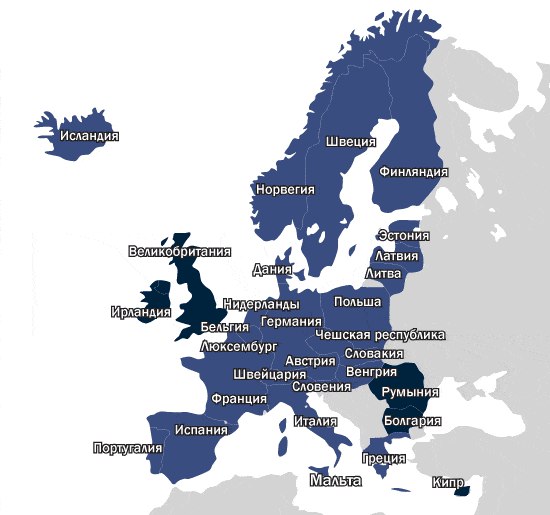
A Schengen visa is a special document that removes restrictions on movement within the Schengen area. The Schengen area is delineated by 26 European states, simplified passport and visa control operates on their territory.
There are different types of Schengen visas. They are classified according to the intention of the entrant, the “corridor” of action – the length of time during which the visa is active, etc. What types of visas are relevant in the Schengen countries?
The Schengen Area unites the following countries:
We have already mentioned that Schengen visas are divided into varieties according to different parameters. These parameters are related to the purpose of stay, the duration of the visa and the number of possible entries.
Four main types of visas:
Type A is a transit visa for air travel. Required if the flight is made with a transfer in several Schengen countries. This visa limits the space of stay to the international zone of the airport. For example, you need to fly to London from Moscow with a transfer in Zurich.
According to the visa requirements for Russian citizens, you do not need to obtain and have a type A transit visa. This rule is true if the duration of docking at the transfer point does not exceed one day. But if you fly on a flight Moscow – London with transfers to Frankfurt am Main and Vienna, you will need to issue a corresponding document.
Type B is a transit visa for land transport. It assumes 1-2 entries and the maximum period of stay of its owner in one territorial unit of Schengen - 5 days. It hasn't been formalized yet.
Type C – short-term visa – up to 90 days (or 3 months) in the Schengen area. This is the most popular type of visa. It is provided regardless of the purpose of the trip – travel, business visit or guest trip. However, the set of necessary documents for multipurpose trips will differ.
Visa C is divided into subspecies.
with different "corridor" (or duration):
C1 is the easiest to obtain a visa with a validity period of 30 days.
C2 is a semi-annual visa. The period of stay in Schengen is up to 3 months.
C3 - annual visa. The period of stay up to 3 months every six months. In practice, most consulates issue such a visa to large businessmen and active tourists who previously received C1 and C2.
C4 – a visa issued to special people: individual representatives of political organizations, diplomats, dignitaries. It assumes a total time - 3 months every six months. The validity of such a visa is from one to five years.
Short-term visas, depending on the number of entries to Schengen, range from single to double-entry and multiple-entry (or multi-visas). A single-entry visa implies a single entry, usually a category C1. Double involves two entries with a total number of stays of 90 days every six months. This is usually a C2 visa. As for the C3 and C4 visas, they are often multiple entries, i.e. they involve an unlimited number of entries. However, it is important to note that any of the short-term visas can be either single and double-entry, or multiple-entry. The decision on how many entries you will be able to make is made by the consulate, so in a special application form you need to specify why you need a certain type of visa.
Consulates of some countries may issue multiple-entry visas on the first application. For example, if you request to the relevant organizations of Finland, Estonia, Spain, France, you can get a multi-visa for a period of 6 months.
It should be noted that short-term visas are not working. Any employment on a category C visa is a violation of the law with consequences. At best, it is forced migration to the homeland. Legal work abroad requires obtaining a visa of the following type.
Type D – national visa, belongs to the category of long-term. Issued not under the Schengen Agreement, but by a specific country. Therefore, the Schengen visa in the usual sense is not. However, thanks to such a visa, you can live in the territory of a certain state with the right to stay in any Schengen country no more than 90 days every six months. In practice, it is issued to students undergoing educational programs abroad, professional athletes, artists, as well as persons with a state of health that does not allow them to leave the Schengen area on a set date. Valid for up to 5 years.

Additional types of visas:
FTD and FRTD (simplified road and rail transit document) are a simplified transit document, which is issued very rarely for the transportation of passengers of the main territory of the Russian Federation to Kaliningrad.
LTV (Limited territorial validity visa) is a short-term visa with a limited territory of validity (usually the territory of one state). The primary function of this visa involves emergency cases of stay of a citizen in a certain country (death of a relative, the need for medical services of this country) or for transit. However, this visa is undesirable – no tourist specifically requests it. Obtaining a visa instead of a Schengen visa may mean that the last stay abroad was not without violations.
We looked at all kinds of existing visas that are relevant for anyone who wants to visit the Schengen countries. When choosing your visa, be guided, first of all, by the rules of stay on it and the previous experience of your travels.
Author of the text: Lilia Vasketsova
Photo: axa-schengen, visa-fast, olx, visaget