Independent tourism and recreation in the city of Tübingen Historical information about the city of Tübingen 1...
 Guide license
Excursions in the south-west of Germany, French Alsace and the famous Alsace Wine Road: Stuttgart, Baden-Baden, Heidelb …
1. The Emergence of Tübingen
Tübingen is an ancient city in southwestern Germany, located in the state of Baden-Württemberg on the Neckar River. Settlements in this area existed in the early Middle Ages, when the region was inhabited by the Alemannes. The first written mention of Tübingen dates back to 1078, when the local fortress was at the center of a military conflict between the German king Henry IV and his opponents.
In the XI-XII centuries, Tübingen gradually turned into a fortified settlement, which had strategic importance due to its location along trade routes. Above the city stood a fortress, later known as the castle of Gauguin-Tübingen.
2. The Middle Ages and the Power of Württemberg
In the Middle Ages, Tübingen was ruled by the Pfalzgraves of Tübingen. In the middle of the XII century, the settlement received city rights, which contributed to the development of trade and crafts.
In 1342 the city passed into the possession of the counts of Württemberg. Gradually, Tübingen became one of the important centers of their possessions. In the fifteenth century, urban administration, religious institutions and trade developed. In 1435-1446 the town hall was built, which became one of the symbols of the historical center.
3. Founding of the University in 1477
The most important event was the founding of the University of Tübingen by Count Eberhard Borodatim in 1477. The educational institution trained specialists in the field of theology, law, medicine and philosophy.
The emergence of the university changed the life of the city. Teachers and students from different regions came here, educational facilities, libraries and hostels were opened. Education gradually became the basis of the economy and cultural identity of Tübingen.
In 1477, the history of the city began as one of the most important university centers in Germany.
4. Reformation and development of science
In the XVI century, Tübingen was at the center of religious transformations. After the spread of the Reformation, the university became an important center of Protestant theology. In 1536, an Evangelical dormitory-seminary was founded here to train priests.
In the following centuries, the city strengthened its scientific reputation. Associated with the university were the humanist Johann Reichlin, botanist Leonart Fuchs and mathematician Wilhelm Schickard, who created one of the earliest mechanical computers.
However, development was repeatedly interrupted by epidemics and wars. During the Thirty Years’ War of 1618–1648, Tübingen faced economic hardship, food shortages, and disease. After the conflict, the city gradually recovered.
5. XVIII century and German philosophy
In the eighteenth century, Tübingen continued to develop as a center of education and theology. The university expanded its training and attracted scholars from all over Germany.
The city is especially famous for the stay of future outstanding thinkers. In 1790-1793, Georg Wilhelm Friedrich Hegel, Friedrich Wilhelm Joseph Schelling and the poet Friedrich Hölderlin studied at the local Evangelical dormitory.
Their activities strengthened the cultural fame of Tübingen. The city became one of the symbolic places associated with German idealism, philosophy and literature.
6. XIX century: modernization and growth of the university
In the XIX century, Tübingen gradually expanded, medicine, natural sciences and humanities developed. In 1863, a separate faculty of natural sciences appeared at the university, and in 1876 the number of students for the first time exceeded a thousand.
The development of railway communication improved the transport accessibility of the city and strengthened its ties with other regions. The number of residential buildings, educational facilities, medical facilities and service enterprises increased.
The university became the main factor in the economic and cultural development of Tübingen.
7. The beginning of the XX century and the world wars
At the beginning of the XX century the university continued to develop. In 1904, women began to study there, which was an important step in expanding access to higher education.
The First World War brought economic hardship and human losses. After the National Socialists came to power in 1933, the university came under ideological pressure. Teachers and staff of Jewish descent, as well as political opponents of the regime, were harassed and fired.
During World War II, the city faced wartime restrictions. After the war, Tübingen entered the American occupation zone, and the university gradually resumed full-fledged scientific and educational activities.
8. Post-war development
After 1945, Tübingen became one of the administrative centers of Württemberg-Hohenzollern. In 1952, it became part of the new federal state of Baden-Württemberg.
In the post-war decades, the city expanded, residential neighborhoods, university buildings, clinics and research institutions were built. In 1977, the university celebrated its 500th anniversary, and by the end of the XX century it had become a major international scientific center.
9. Tübingen in the XXI century
Today, Tübingen is known as a university city with a developed scientific, medical and cultural infrastructure. The University conducts research in medicine, biology, neurosciences, humanities and information technology.
The city combines medieval architecture with modern urban environment. The historic center, Gauguin-Tübingen Castle, the town hall and the Neckara embankments preserve the memory of the past, and scientific institutes and university clinics reflect modern development.
10. Historical heritage of the city
Tübingen went from a medieval fortified settlement to one of the most famous university centers in Germany. Its development was determined by the power of the counts of Württemberg, religious transformations, philosophical traditions and scientific achievements.
The main feature of the city is the close connection of history, education and culture. Thanks to the university, historical architecture and active social life, Tübingen retains its importance as an important intellectual and cultural center of southwestern Germany.
1. The tourist attraction of the city of Tübingen
Tübingen is one of the most picturesque university cities in Germany, located in the federal state of Baden-Württemberg on the banks of the Neckar River. The city is known for its well-preserved medieval center, old half-timbered houses, a prestigious university founded in 1477, and a special student atmosphere. It harmoniously combines centuries-old history, modern culture and natural landscapes, which makes Tübingen attractive for independent travelers, families and fans of European architecture.
2. Medieval atmosphere and historical center
The main feature of Tübingen is its historical center, which practically preserved the layout of the Middle Ages. Narrow cobbled streets, colorful half-timbered houses of the XV-XVII centuries, ancient squares and cozy courtyards create the atmosphere of old Germany.
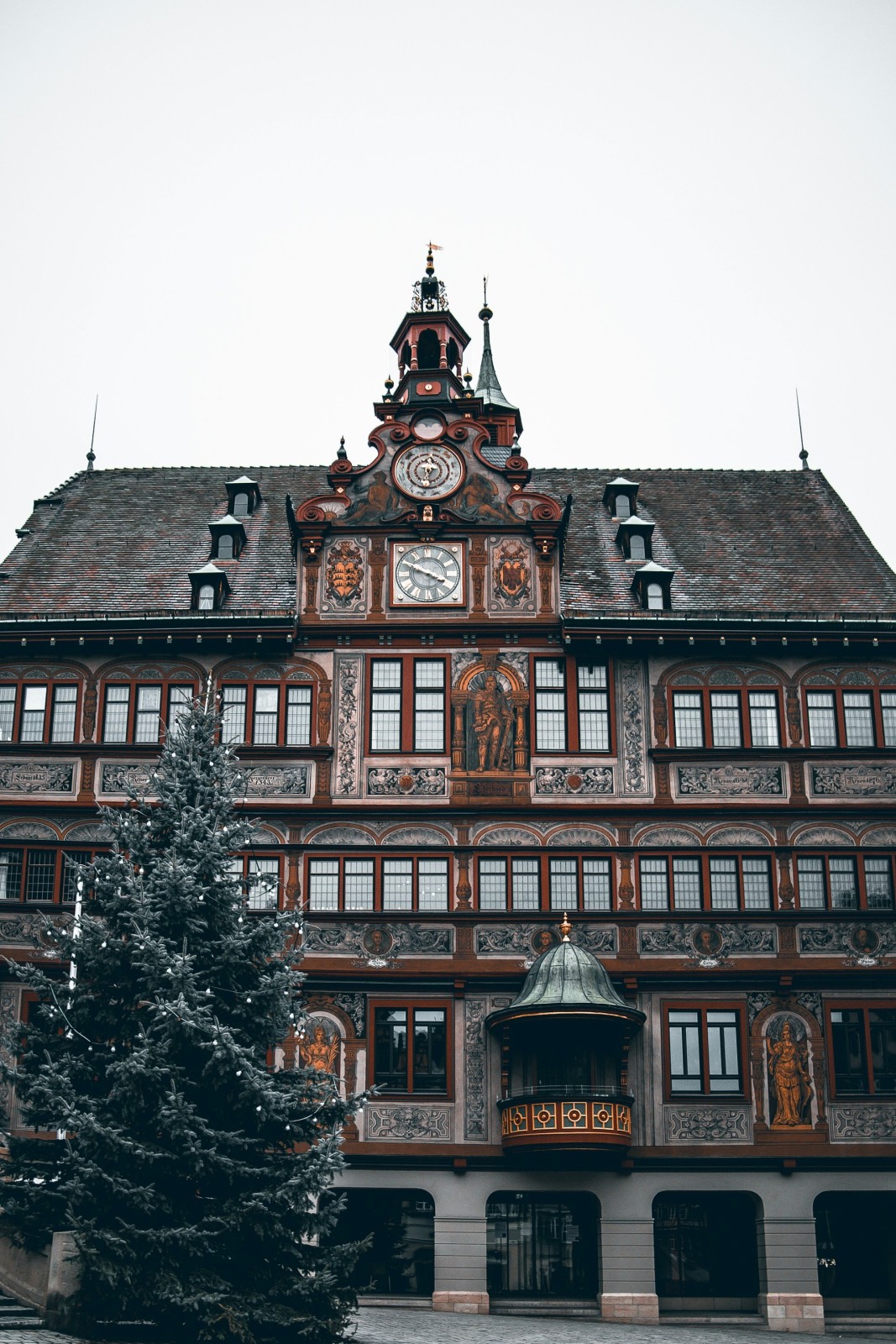
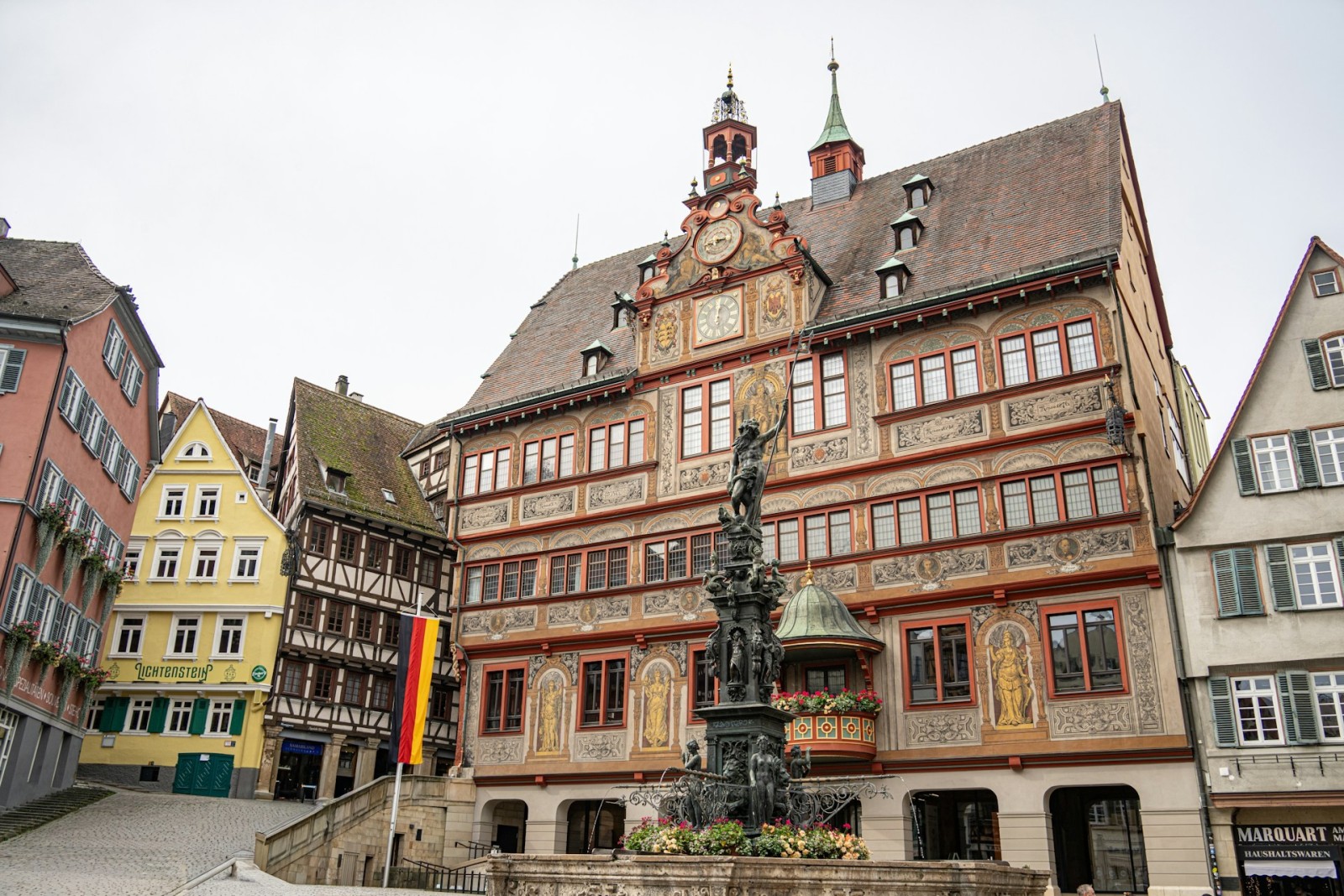
The center of urban life is the Market Square (Marktplatz), where the famous painted town hall with an astronomical clock is located. Around the square there are cafes, pastry shops and small shops, where it is pleasant to spend time after a walk.
Unlike many major German cities, Tübingen escaped extensive destruction during World War II, so there are many authentic historic buildings.
3. One of the oldest universities in Germany
The University of Eberhard and Karl is considered the main symbol of the city. It was founded in 1477 and is one of the oldest universities in Europe.
It was here that philosopher Georg Wilhelm Friedrich Hegel, poet Friedrich Hölderlin and philosopher Friedrich Schelling studied. The university atmosphere is felt everywhere: there are many students, bookstores, libraries and cozy cafes on the streets, where literary meetings and scientific discussions take place.
For tourists, the historical buildings of the university, courtyards and buildings of different eras are of interest - from medieval to modern research centers.
4. Walks on the Neckar River
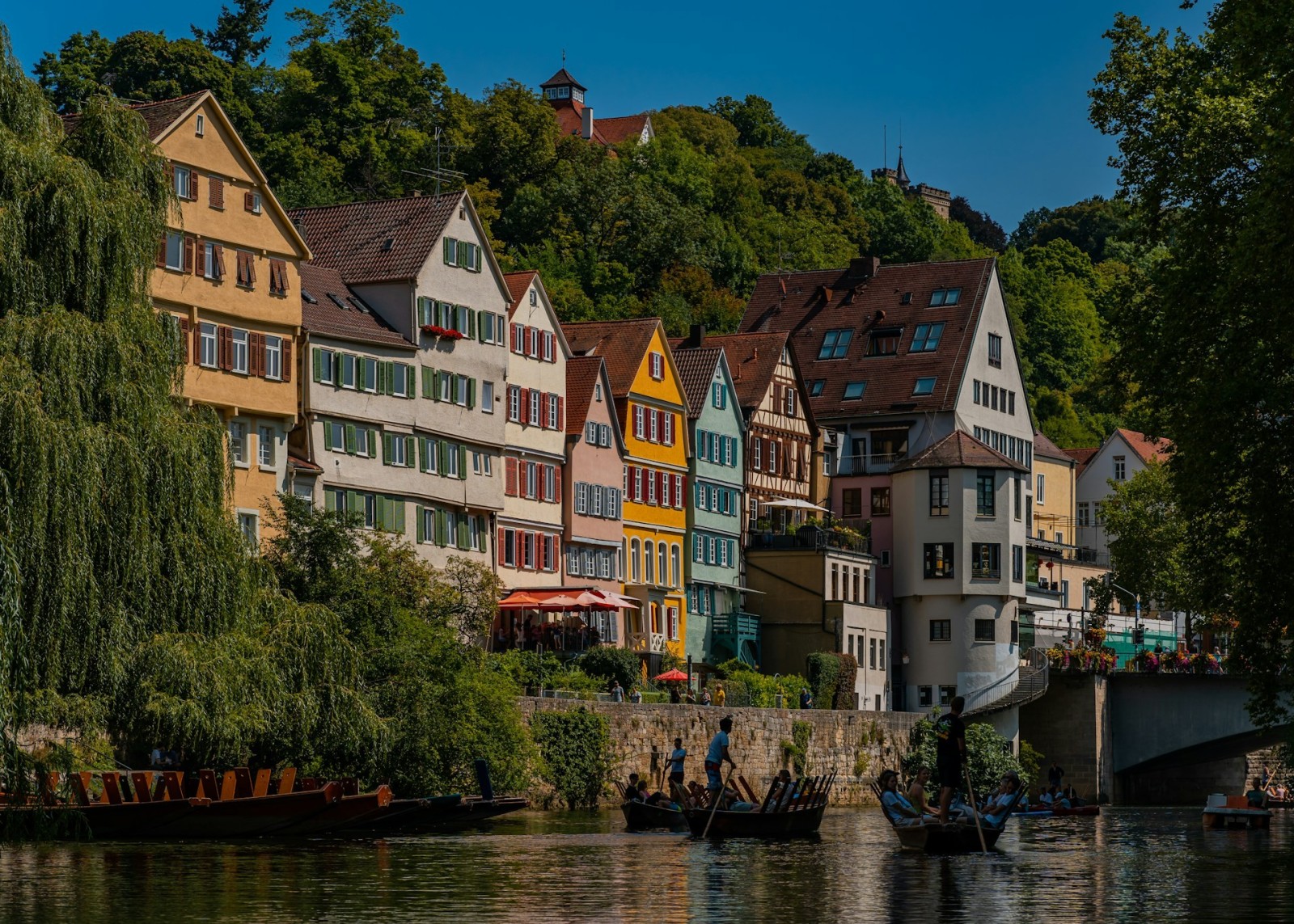
One of the hallmarks of the city was the Neckar River. Its embankments are considered one of the most beautiful places in Tübingen.
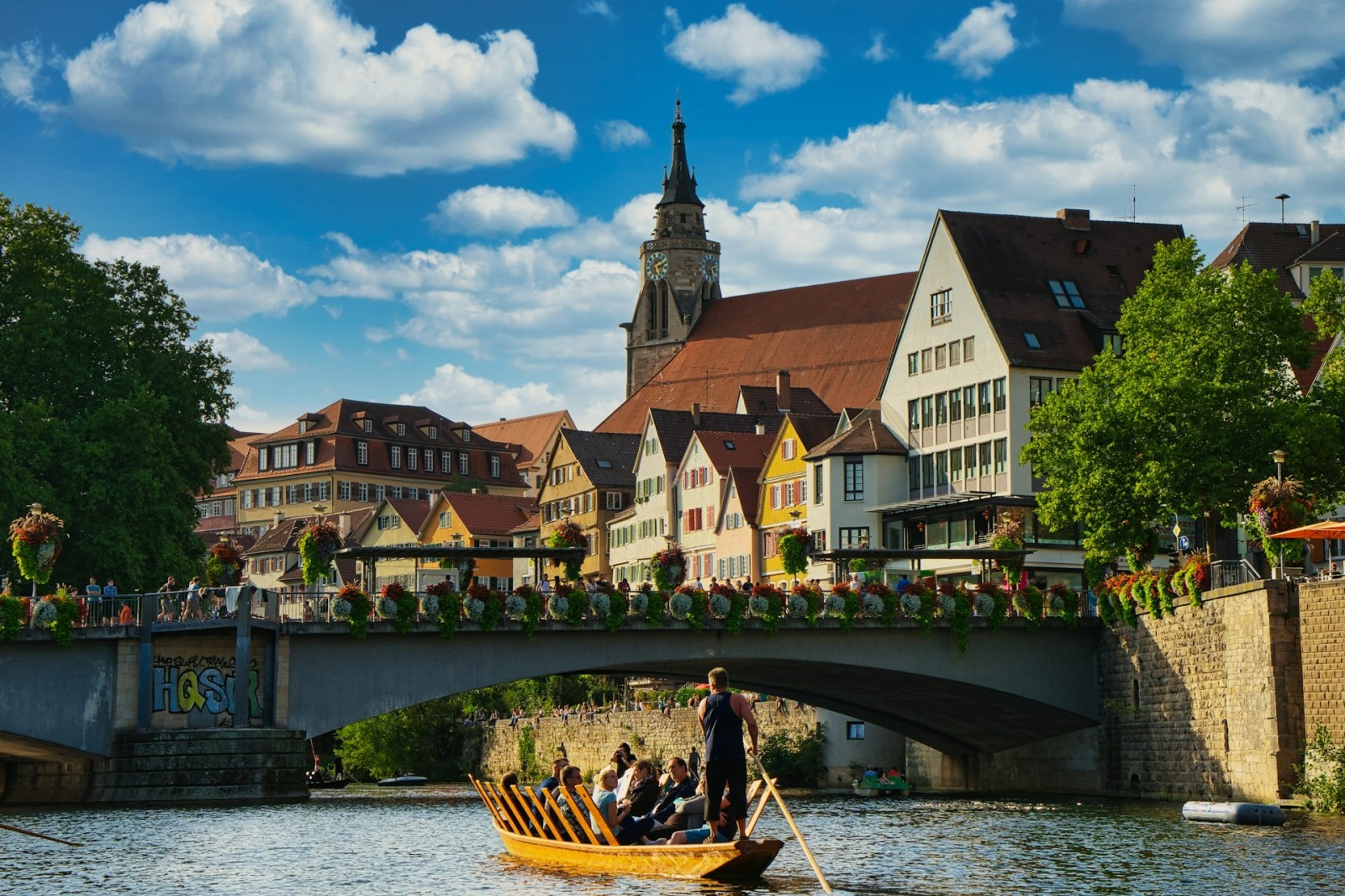
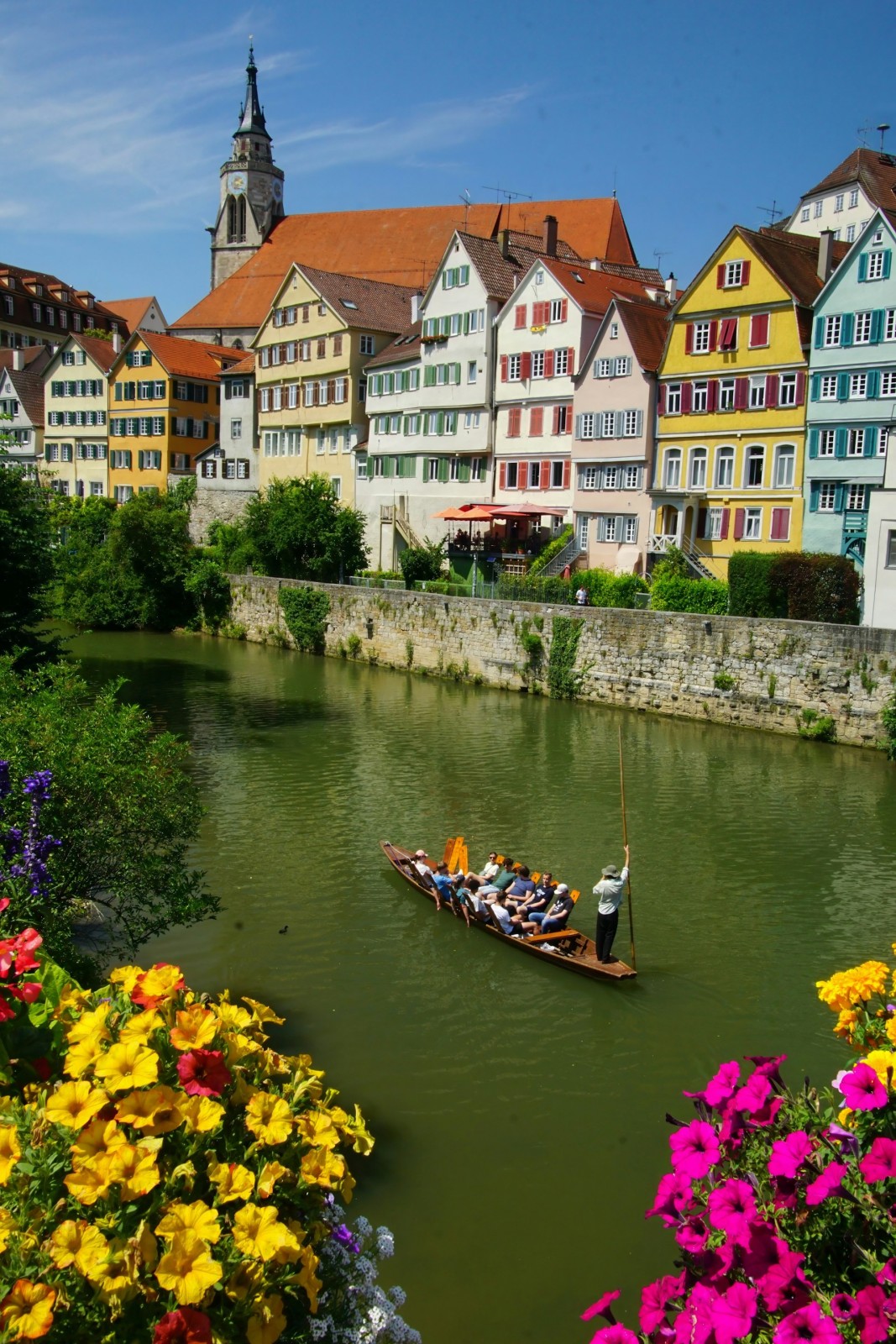
Traditional long wooden boats are especially popular - stocherkahn. They are controlled by boaters, pushing long poles from the bottom, which resembles the famous walks in Cambridge or Oxford.
During the walk, the best views of the old city, church towers, half-timbered houses and the famous Yellow Tower of Hölderlin open.
In spring and summer, river walks become one of the most popular entertainment among tourists.
5. Gauguin-Tübingen Castle
The castle rises above the city and is one of the most recognizable sights.
Initially, it served as a fortress of medieval rulers, and later was repeatedly rebuilt in the Renaissance style. Today in its walls is the Museum of the University of Tübingen.
Here you can see archaeological finds, works of art and famous ancient musical instruments found in the caves of the Swabian Alba.
From the site near the castle, a magnificent panorama of the city, the Neckar River and the surrounding hills opens.
6. Rich cultural life
Despite its relatively small size, Tübingen has a rich cultural program.
During the year, there are:
music festivals;
Theatrical productions;
literary evenings;
art exhibitions;
student holidays;
Christmas markets.
Especially lively is the atmosphere in the summer, when concerts are held directly on the city squares and embankments.
7. Cafes, restaurants and gastronomy
Tübingen is known for a large number of cozy cafes thanks to numerous students.
Here you can try:
traditional German dishes;
Swabian cuisine;
fresh pastries;
local wines of the Württemberg region;
modern European dishes.
The most popular are small family restaurants located in the historical center.
1. High-level hotels
Tübingen is dominated by small city hotels and medium-sized hotels. Classic five-star hotels are limited, so travelers who are interested in spacious rooms, a restaurant and a high level of service should pay attention to the best four-star and boutique hotels.
Hotel Krone is a comfortable hotel in the central part of the city, suitable for travelers who want to live near the historic streets and the Neckar waterfront. Convenient for cultural recreation and business trips.
Hotel La Casa is a modern hotel with designer interiors and a wellness area. Suitable for tourists who prefer increased comfort and a calm atmosphere.
Domizil Tübingen is a hotel near the Neckar River and the old town. Its location is convenient for walking around the historic center, visiting restaurants and main attractions.
In this category, you can usually count on a separate bathroom, daily cleaning and additional services. Restaurant, parking, sauna and other amenities should be specified when booking.
2. Mid-price hotels
This is the most common option for tourists who want to get a comfortable room and convenient location without the cost of expensive hotels.
ibis Styles Tübingen is a modern chain hotel close to the train station and the historic center. Suitable for short trips, family holidays and business visits.
Hotel am Schloss is a three-star elevated hotel in the historic part of the city, next to Gauguin-Tübingen Castle. A good choice for those who want to live surrounded by ancient architecture.
Hotel Restaurant Meteora is a hotel with a restaurant offering Greek cuisine. Suitable for tourists who need food on the spot and the ability to reach the center on foot or by public transport.
Koncept Hotel Neue Horizonte is a modern hotel in a more peaceful part of the city. Suitable for travelers who prefer functional rooms and do not necessarily want to stay in the center.
Such hotels usually have their own bathroom, Wi-Fi, TV and the ability to order breakfast. Some hotels offer parking and accommodation with pets.
3. Inexpensive hotels and hotels such as Garni
Hotels such as Garni are focused mainly on accommodation and breakfast, without full restaurant service. They are suitable for tourists who spend most of the day outside the hotel.
Hotel Garni Venezia is a small family hotel in the Lustnau area. Suitable for relaxing holidays and travelers who are ready to use the bus or walk to the historic center.
Hotel am Kupferhammer is a small hotel near the West Station. It can be suitable for tourists arriving by train or car.
Hotel Katharina Garni is a hotel in a residential area on a hill. Suitable for those who prefer a calm atmosphere and do not mind walking to the center.
Hotel am Bad is an option outside the busiest part of the city that is worth considering when looking for a more relaxed stay.
Such hotels are often more profitable than expensive hotels, especially when traveling for several nights. However, the cost depends on the season, day of the week, type of room and on meals.
4. Hostels and youth hotels
DJH Jugendherberge Tübingen is a youth hostel on the banks of the Neckar, near the historic center. It is suitable for students, young travelers, cyclists and organized groups.
Hostels usually offer multi-bed rooms, shared bathrooms and recreational facilities. In some cases, a separate number can be selected. Meals can be provided for an additional fee or included in the selected tariff.
Before booking DJH Jugendherberge Tübingen, it is worth clarifying the rules of membership in the organization of youth hostels: a membership card or an appropriate confirmation may be required for accommodation.
5. Apartments and apartments per day
The apartments are suitable for tourists who want to cook their own food, have more personal space and do not depend on the schedule of the hotel restaurant.
Cloud N°7 Studios is a studio in the central part of the city, near the train station and the old town. Suitable for independent travelers and long trips.
Appartements am Schloss is an apartment next to the historic center and castle. Convenient for those who want to cook on their own and live in the old part of the city.
Appartement 1906 is an option for tourists who need a separate kitchen, a more homely atmosphere and the ability to organize meals on their own.
Apartment König is an apartment near the old town suitable for couples and small families.
1. Gauguin-Tübingen Castle (Schloss Hohentübingen)
The castle is located on a hill above the historical center and is one of the main attractions of the city. Its history begins in the Middle Ages, and later the fortress acquired the features of a Renaissance palace. Today there are museum collections of the University of Tübingen dedicated to archaeology, ancient cultures and art history.
Visitors are interested in the ancient courtyards, historical premises and panoramic views of the roofs of the old city and the Neckar Valley.
Transport accessibility: you can walk from the Market Square in about 10-20 minutes. The path goes uphill, so people with limited mobility should consider a steep climb. By car you can reach the nearest accessible streets, but parking in the historic center is limited.
2. Market Square and Town Hall (Marktplatz and Rathaus)
The market square is the heart of old Tübingen. It is surrounded by colorful half-timbered houses, cafes and small shops. The main architectural decoration is the town hall with a decorative facade and an astronomical clock.
The square is suitable for walking, relaxing in a cafe and exploring the traditional architecture of southern Germany. City events and seasonal fairs are also held here.
Transport accessibility: the square is located in the pedestrian part of the historic center. The main train station can be reached in about 10-15 minutes. City buses stop in the area of the center, but directly on the area of traffic is limited.
3. Old Town (Altstadt)
The historical center of Tübingen has preserved its medieval layout, narrow streets, stairs, old houses and small squares. A walk along it allows you to see the architecture of different eras and feel the atmosphere of the university city.
Especially interesting are the streets around the Market Square, old alleys, small courtyards and buildings associated with the history of the local university. In the center there are shops, restaurants, book shops and pastry shops.
Transport accessibility: It is most convenient to explore the old town on foot. From the railway station the road takes about 10-15 minutes. Some streets are paved with stone and have steep climbs, so for cyclists and visitors with limited mobility, separate routes can be uncomfortable.
4. St. George Cathedral Church (Stiftskirche St. Georg)
It is one of the main historical churches of Tübingen, built mainly in the late Gothic style. Inside are preserved old stained glass windows, works of religious art and tombstones of representatives of the Württemberg dynasty. When the tower is open to the public, you can go upstairs and see the panorama of the roofs of the old city.
Transport accessibility: The church is located on Holzmarkt Square, a short walk from Market Square. From the station you can walk in about 10-15 minutes. Bus stops are located in the central part of the city. The ability to visit the interior and tower depends on the schedule of services and mode of operation.
5. Hölderlin Tower (Hölderlinturm)
The tower on the banks of the Neckar is connected with the life of the German poet Friedrich Hölderlin, who spent the last decades of his life here. The building has a museum dedicated to his biography, literary heritage and stay in Tübingen.
This place is especially interesting for lovers of German literature, history and philosophy. The tower is also part of the city’s famous riverscape.
Transport accessibility: you can walk from the station in about 10-15 minutes, and from the Market Square in a few minutes. It is most convenient to visit the tower while walking along the Neckar.
6. Neckara Quay and Neckarinsel Island (Neckarfront and Neckarinsel)
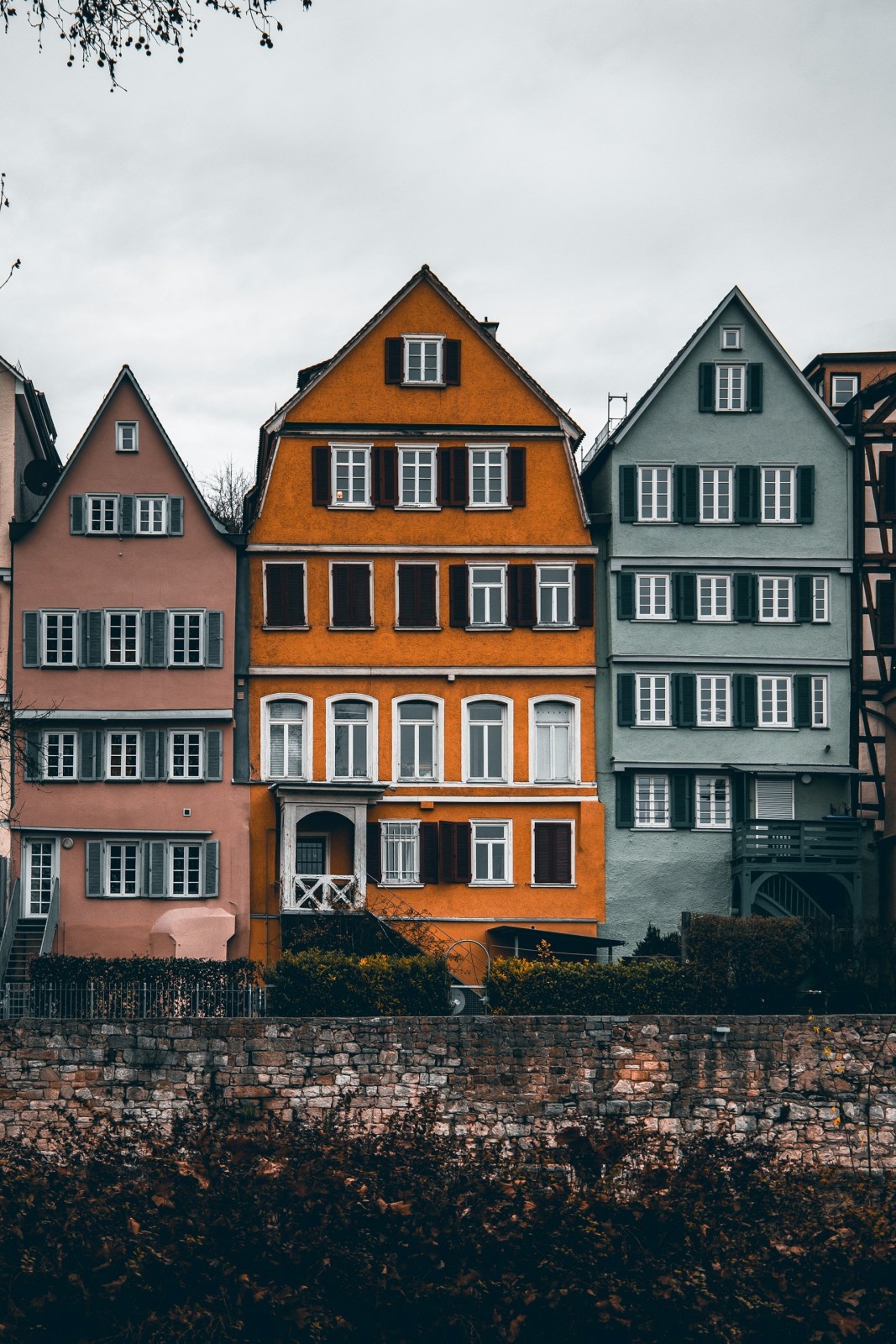
Neckara embankment is one of the most recognizable places in Tübingen. Along the river lined historic houses with colorful facades and high roofs. A particularly beautiful view opens from the Neckarbrücke Bridge.
Nearby is the island of Neckarinsel with a shady plane alley, where you can relax, walk and watch boats. In the warm season, walks are popular on traditional flat-bottomed boats - Shtocherkahn.
Transport accessibility: the promenade and the island are located directly near the center. From the station to the bridge Neckarbrücke can be reached in about 5-10 minutes, after which continue a walk along the river. Pedestrian crossings lead to the island; public transport is usually not required to visit these places.
7. Old University Building (Alte Aula)
The old university assembly hall is a historic building associated with the development of the University of Tübingen, founded in 1477. It served as an important center of university life for several centuries.
The object is interesting architecture, history of education and connection with the intellectual tradition of the city. There are other university buildings and St. George’s Church nearby, so it is convenient to combine a visit with a walk in the center.
Transport accessibility: the building is located in the historic part of the city. You can walk from the Market Square in a few minutes, from the station in about 10-15 minutes. Access inside depends on the activities and mode of operation.
8. Evangelical Monastery Seminary (Evangelisches Stift)
The historic building of the former Augustinian monastery became famous thanks to the training of Protestant theologians. Hegel, Hölderlin and Schelling studied here, who had a great influence on German philosophy and literature.
The building is of interest to travelers studying the history of university education and the intellectual life of Germany. This is an active educational and residential institution, so free access to all premises is not guaranteed.
Transport accessibility: The seminary is located near the old town and university buildings. It is convenient to reach on foot from Market Square and St. George’s Church.
9. City Museum in the Cornhouse Building (Stadtmuseum Tübingen)
The City Museum is located in the historic building of the former granary. Its expositions tell about the history of Tübingen, everyday life of citizens, cultural development and changes of the city in different eras.
This is a suitable place for those who want to better understand the history of the city after walking through its streets. The museum is also interesting to visitors who prefer to get acquainted with the place through historical objects and thematic exhibitions.
Transport accessibility: the museum is located in the old town, on Kornhausstrasse Street. The train station can be reached in about 10-15 minutes. The nearest bus stops are Stadtgraben and Neckarbrücke, which require a short walk.
1. Carnival procession (Tübinger Fasnetsumzug) usually takes place in January or February. Participants wear traditional costumes and masks, pass through the streets of the city, arrange musical performances and festive performances.
2. The ChocolART International Chocolate Festival is usually held in late November or early December. In the historical center there are shopping pavilions from different countries, tastings, master classes and presentations of chocolate products.
3. Christmas market (Tübinger Weihnachtsmarkt) – is organized in December, usually on one of the weekends before Christmas. On the Market Square and neighboring streets sell holiday decorations, souvenirs, pastries and hot drinks.
4. The Latin American Film Festival (CineLatino) usually takes place in the spring. The program presents films from Latin America and the Spanish-speaking world, special screenings and meetings with representatives of the film industry.
5. The Spring Market (Frühlingsmarkt) is a seasonal event with regional products, handicrafts and locally produced goods. Additional trade and cultural events may be held depending on the programme.
6. Antique Market (Antiquitätenmarkt) - allows you to purchase antique books, interior items, jewelry, dishes and collectibles. Dates depend on the organizers.
7. Traditional boat race (Tübinger Stocherkahnrennen) is usually held in late spring or early summer, often in June. Teams compete on long flat bottom boats driven by poles. Spectators watch the competition from the banks of the Neckar.
8. The Festival of Alternative Music and Community Initiatives (Ract!festival) is a summer event that brings together live music, cultural performances, public discussions and youth initiatives.
9. African Festival of Culture (Afrika-Festival Tübingen) - introduces visitors to the music, dance, cuisine and cultural traditions of different countries of Africa. The program may include concerts, master classes and trading platforms.
10. Classical Music Festival (vielklang-Festival) is held mainly in the summer. The program includes chamber concerts, performances of professional musicians and young performers.
11. The Umbrisch-Provenzalischer Markt is usually held in September. Producers from Italian Umbria and French Provence present cheeses, olive oil, sausages, spices, sweets and other regional products.
12. Days of Jazz and Classical Music (Tübinger Jazz- und Klassik-Tage) is a music event that is usually held in October. Concerts are held in different halls and cultural spaces of the city.
13. French Film Festival Days (Französische Filmtage) are held in autumn, usually at the turn of October and November. The program features French and French-language films, special screenings and events dedicated to European cinema.
14. Martinimarkt is a traditional autumn market, usually held in November. The shopping arcades feature seasonal goods, products, craftsmen's products and everyday items.
1. Winter
Air temperature: during the day usually from 0 to +6 ° C, at night about -4 to +2 ° C. In some periods, frost, snow and ice are possible, but stable snow cover in the city is not always.
Water temperature: The water in the Neckar River usually has a temperature of about +2...+7 °C. It is too cold for a comfortable swim.
In winter, there are often cloudy days, fogs and small precipitation. Walking through the historic center will require warm clothes, waterproof shoes and protection from the wind.
This is a good time to visit museums, old churches, university buildings, cafes and the Christmas market. Tourists are usually less than in summer, but the daylight hours are short.
2. spring
Air temperature: in March afternoon usually +7 ... +12 ° C, in April +12 ... +17 ° C, in May +16 ... +21 ° C. At night, the temperature can drop to 0... +10°C.
Water temperature: in Neckar in spring is usually around +5. +15 °C, gradually increasing by the beginning of summer. Swimming at this time is usually uncomfortable.
In March, the weather is still cool and changeable. In April, it gets warmer, the first flowering trees appear, and in May the city is especially attractive due to green parks and lively embankments.
Spring is suitable for walking tours, visiting the castle of Gauguin-Tübingen, walking along the Neckar and visiting the university botanical garden. In May, it is already comfortable to spend a lot of time outdoors, although an umbrella is still needed.
3. Summer.
Air temperature: during the day usually + 21 ... + 26 ° C, sometimes the temperature exceeds + 30 ° C. At night, most often +11... +15°C.
Water temperature: in the Neckar River in the summer approximately +16. +22 °C, but the actual temperature depends on the weather and current. Bathing is allowed only in safe and permitted places.
Summer is considered the warmest and one of the most popular seasons to visit the city. The days are long, open cafes are open, music festivals, cultural events and a traditional boat race are held.
At the same time, June, July and August can be rainy: thunderstorms and short-term downpours are possible. For excursions, it is better to choose light clothes, comfortable shoes and take a raincoat with you.
Summer is especially suitable for boating, relaxing on the banks of the Neckar, traveling around the neighborhood and attending open-air events.
4. autumn
Air temperature: in September afternoon usually + 17 ... + 22 ° C, in October + 12 ... + 16 ° C, in November + 6 ... + 10 ° C. At night, the temperature gradually decreases from about +8 ... + 12 ° C in September to 0 ... + 5 ° C in November.
Water temperature: in early autumn in Neckar can remain about +15. +20 °C, by November it usually drops to about +5 °C. +10°C.
September often retains pleasant summer weather, so it is suitable for long walks and excursions. In October, the city is decorated with autumn colors, and in November the number of cool and cloudy days increases.
In autumn, it is worth visiting the historical center, museums, university buildings and gastronomic markets. For walks, it is desirable to have a jacket, closed shoes and an umbrella.
1. Language of communication in Tübingen
1. German is the main language of communication in Tübingen and official institutions of Germany. It is spoken in shops, restaurants, hotels, public transport and medical facilities. In everyday speech, residents can use Swabian dialectal features characteristic of southwestern Germany.
2. English is quite common due to the university and a large number of foreign students and researchers. English can usually be explained in hotels, tourist spots, university environments and many restaurants. However, in small shops and when applying to public institutions, knowledge of German may be necessary.
3. French and other foreign languages are found among university staff, foreign students and tourism workers, but one should not count on free communication in them everywhere.
4. Features of communication - Germans usually appreciate politeness, clarity of wording and respect for personal space. When addressing strangers and institutional staff, it is appropriate to use a polite "Sie" instead of an informal "du." In the university environment and among young people, the transition to informal communication is more common.
2. Traditions and customs
1. Punctuality. In Germany, it is customary to come on time for excursions, meetings, concerts and pre-booked events. When late, it is advisable to warn the receiving party.
2. Welcome. When meeting, they usually say “Guten Tag” – “Good afternoon”, “Guten Morgen” – “Good morning” or “Hallo” – “Hello”. In small shops and cafes it is customary to say hello at the entrance and thank when leaving.
3. Respect for silence. In residential areas, loud music and noise should be avoided, especially in the evening and at night. Night rest is common in Germany, usually between 22:00 and 6:00, although specific rules may depend on local regulations and living conditions.
4. Table rules. In restaurants, it is customary to wait for an order, not to talk too loudly and thank the staff. Tipping is optional, but rounding the bill or adding about 5-10% for good service is common.
5. Waste sorting. In Germany, garbage is divided into categories: paper, packaging, glass, organic waste and residual garbage. In hotels and apartments, it is desirable to use the designated containers and follow the rules of a particular object.
6. Respect for historic buildings. In the old city, you should take care of architectural monuments, do not leave garbage and do not go beyond the fence. In churches, it is necessary to observe silence, and during worship services do not interfere with parishioners.
7. University culture. Tübingen is a major university city. It is customary to respect students, teachers and scientific institutions. Entrance to academic buildings, libraries and university premises may be restricted, so access rules should be clarified before visiting.
8. Local holidays. During city festivals, Christmas market and boat races, it is necessary to follow the instructions of the organizers, do not interfere with participants and take into account time restrictions of movement.
3. Basic laws and regulations for tourists
1. Documents. When traveling, you must have a valid passport or other document recognized for entry and stay in Germany. For EU citizens, a valid national identity card is usually sufficient. Foreign tourists should check visa requirements and entry conditions in advance depending on their nationality.
2. Term of stay. For non-EU nationals, short-term trips to the Schengen area are normally subject to a rule of no more than 90 days in any 180-day period, unless the applicable status or permit provides otherwise. For EU citizens and long-term permit holders, other rules apply.
3. Alcohol and smoking. The sale and consumption of alcohol is subject to age restrictions. Beer and wine in Germany are allowed from the age of 16, spirits - from 18 years. Smoking is prohibited in a number of public spaces and is governed by separate regulations; restrictions also apply to e-cigarettes in their respective locations.
4. Public transportation. A valid ticket is required prior to travel unless travel is included in another permitted fare. Ticketless travel can lead to a monetary penalty. When using regional trains and buses, the conditions of a particular ticket and fare area should be taken into account.
5. Traffic rules. Pedestrians need to cross the road in the prescribed places and observe traffic lights. Cyclists should use permitted tracks and comply with road sign requirements. Driving while intoxicated is illegal in Germany; there are strict alcohol restrictions for drivers.
6. Photography. Removal of buildings and attractions for personal use is usually allowed, unless there are special restrictions. When filming people should take into account their right to privacy and image. In museums and exhibition halls, photography may be restricted by the institution’s rules.
7. Conservation. In parks, forests and natural areas, it is necessary to follow the designated routes, not to leave garbage and not to damage plants. Additional restrictions may apply in protected areas.
8. Medical care. In an emergency, call 112. The number 110 is used to contact the police. Tourists are advised to have health insurance covering the costs of treatment and emergency care.
9. Payment for goods and services. Bank cards are widely accepted in Germany, but small establishments and markets may require cash payments. Before ordering a service or booking accommodation, you should specify the final cost and possible additional fees.
10. Behavior in public places. It is forbidden to damage property, threaten people, disturb public order and ignore the lawful demands of the police. Fines or more serious penalties may apply for individual violations.
1. Essential German words for traveling around Tübingen
Hallo, halo, hello.
Guten Morgen - good morning.
Guten Tag — guten so — good day.
Guten Abend - Guten Abent - good evening.
Tschüss - chuss - bye.
Auf Wiedersehen - Auf Viderzeen - goodbye.
Bitte, beate, please.
Danke, thank you.
Vielen Dank — Philen Dunk — thank you very much.
Entschuldigung — Entschuldigung — sorry.
Ja, I am.
Nein - nain - No.
Vielleicht - Fileicht - perhaps.
Gut-gut-good.
Hilfe! - Help me!
2. Phrases for communicating with locals
Wie geht es Ihnen? - How are you?
Gut, danke. Und Ihnen? - All right, thanks. And you?
Sprechen Sie Englisch? - Sprechen Zie Englisch? - Do you speak English?
Ich spreche nur ein bisschen Deutsch. - their Sprehe noor ain bishan deutsch - I speak German only a little.
Können Sie mir bitte helfen? - Could you help me?
Ich verstehe nicht. I don't understand.
Können Sie bitte langsamer sprechen? - Could you speak more slowly?
Wie heißt das auf Deutsch? - What do you call it in German?
Können Sie das bitte wiederholen? - Could you say it again?
Vielen Dank für Ihre Hilfe. - Philen dank für ye hilfe - Thank you very much for your help.
3. Words and phrases for the hotel
Ich habe eine Reservierung. I have a reservation for them.
Ich möchte ein Zimmer buchen. I'd like to reserve a room.
Haben Sie ein freies Zimmer? - Haben zi ain freyes chimer? - Do you have a room available?
Ist das Frühstück inklusive? - Is it true? - Is breakfast included?
Um wie viel Uhr ist der Check-out? - Mind wi fil ur or der cheque-out? - What time do I have to leave?
Gibt es WLAN? - Is there Wi-Fi?
Können Sie ein Taxi rufen? - Könen zi ain taxi rufen? - Could you call a taxi?
Wie viel kostet eine Nacht? - What do you think? - How much does one night cost?
1. Traditional dishes and local products of Tübingen
Tübingen is located in the state of Baden-Württemberg, in the historical region of Swabia. Therefore, the local cuisine is dominated by hearty dough dishes, meat products, seasonal vegetables, pastries and products of small regional producers. As edible souvenirs, you should choose products indicating the region of origin.
1. Maultaschen (Maultaschen) - traditional Swabian dough products with filling of meat, spinach, onions and spices. They are served in broth, roasted with onions or cooked in a pan. For travelers, this is one of the most characteristic tastes of the region. Packed maultashens can be purchased as a souvenir if the conditions of transportation and storage allow.
2. Spätzle are small egg dough products that are often served as a side dish to meat, sauces or cheese. Dry spetsle is convenient to bring home: they are stored for a long time and easy to prepare.
3. Kezespetzle (Käsespätzle) is a hot dish made of spetsle with melted cheese and fried onions. It is worth trying in local restaurants and traditional Swabian establishments.
4. Swabian onion pie (Zwiebelkuchen) is a pastry with onions, eggs, cream or sour cream, sometimes with the addition of bacon. It is especially popular in autumn, when it can be found at seasonal markets and gastronomic events.
5. Brezeln - pretzels made of yeast dough with a characteristic brown crust and a large salt. They can be bought in bakeries and eaten while walking. For long-term transportation, it is better to choose dry pastries with a long shelf life.
6. Swabian sausages and meat products - the region offers a variety of sausages, smoked meats and delicacies. When buying, you should specify the composition, storage conditions and the possibility of importing the product to the destination country.
7. Regional cheeses and dairy products – local and neighbouring farm produce can be found in shops and markets. Hard cheeses in sealed packaging are better suited for transportation if their import is allowed by the rules of the destination country.
2. Sweets and chocolate
1. Tubingen chocolates (Tübinger Kirschle) are a local chocolate specialty that can be purchased as a gift. Candies are convenient to bring home, and their packaging is often suitable for a small souvenir.
2. Chocolate praline and handmade candies – Tübingen is known for its chocolate theme, in particular thanks to the international festival chocolART. In local pastry shops you can find chocolate with various fillings, nuts and fruits.
3. Praline Palmer is another version of a chocolate gift associated with local gastronomic products. Suitable for those who prefer small sweet souvenirs.
4. Wibele is a small traditional Swabian cookie that is usually sold in packages. It is convenient for transportation and storage, so it is suitable for gifts to colleagues, friends and relatives.
5. Honey and honey sweets - products of local beekeepers are found in markets and in specialized stores. You can choose a jar of honey or sweets based on it, paying attention to the origin and composition.
3. Drinks and products for home use
1. Apple juice from local gardens (Tübinger Apfelsaft) - the region is known for gardens with fruit trees and drinks from local raw materials. Closed juice will be a good edible souvenir if its weight and transportation conditions are suitable for a trip.
2. Pear juice (Birnensaft) - in regional markets you can find juice from certain varieties of pears. There are also more unusual products from pears, including drinks from fruits of old garden varieties.
3. Honey drink (Honigwein) is a drink based on honey, which is presented among regional products. Before buying it is necessary to clarify the content of alcohol and transportation rules.
4. Regional mustard (Hausmachersenf) is a traditional locally produced mustard. A small can is suitable as a practical souvenir for lovers of cooking.
5. Schwäbische Alb-Linsen is a regional product used in soups, side dishes and traditional dishes with lentils and spetsle. Dry lentils are convenient for transportation and stored for a long time subject to storage conditions.
6. Local wines, gin and whiskey - in specialty stores there are drinks from regional producers. This is an option for adult travelers; customs restrictions, alcohol allowances and transportation conditions should be considered before buying.
1. Safety of rest in Tübingen
1. Personal items. In the city center, markets, train station and during festivals, do not leave bags and phones unattended. Keep copies of documents separate from the originals.
2. Moving around town. Keep a close eye on bike lanes and do not walk on them unnecessarily. In Germany, cyclists can move fast enough, and pedestrians must follow traffic signs and traffic lights.
3. Walking by the Neckar River. On the promenade and near the water, be careful, especially in rainy weather and in the dark. Do not swim in unfamiliar places and take into account the flow of the river.
4. Evening walks. At a later time, choose illuminated streets, check the timetable of public transport and the way to return to the hotel.
5. Medical care. When traveling, take the necessary personal medicines in the original packaging. For drugs that may be subject to special regulations, check the requirements for cross-border transportation.
6. Papers and money. Keep your passport and other important documents in a safe place. It is useful to have electronic copies available even if you lose your phone.
2. What documents do tourists need?
1. A foreign passport. Non-EU nationals usually require a valid passport. For short-term travel within the Schengen area, a passport must normally be issued within the last 10 years and valid for at least three months after the intended departure from the Schengen area. Specific requirements depend on nationality and type of document.
2. Visa or entry permit. The need for a visa depends on citizenship, purpose of travel and duration of stay. EU citizens and some other categories of travelers do not require a visa for a short-term tourist trip.
3. Confirmation of residence. It is advisable to have a hotel reservation, apartments or the address of the place where the tourist will be stopped.
4. Return ticket or confirmation of further route. The border authorities may request such documents.
5. Confirmation of funds. In some cases, the traveler needs to show that he has enough money to stay and return home.
6. Juvenile papers. When traveling with children, check the requirements for their passports, visas and travel documents, especially if the child is traveling with only one parent or accompanying person.
7. Copies of documents. It is recommended to keep separate copies of passport, visa, insurance and bookings to facilitate the restoration of documents in case of loss of originals.
3. Health insurance
1. Travel health insurance. For travelers who require a Schengen visa, health insurance is usually mandatory and must meet the visa requirements. It is also highly recommended for other tourists.
2. Medical expenses. The policy should cover emergency care, hospitalization, necessary examinations and medical transportation in the cases provided for in the contract.
3. Repatriation. It is desirable that the insurance includes the costs of medical evacuation or return to the homeland for medical reasons.
4. Additional risks. If you are planning active recreation, sports or travel with special medical needs, you should check whether they are covered by insurance coverage.
5. European Health Insurance Card (EHIC) Citizens and other persons entitled to such a card in the public health insurance system of the EU countries can use it to obtain the necessary state medical care under the conditions provided for in the rules. It does not replace full travel insurance and usually does not cover repatriation.
Create a query and local guides will offer you the best options

Install the app «PersonalGuide»
www.personalguide.ru

