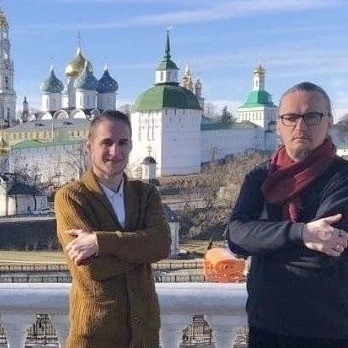
(since 1782 - Sergievsky (Sergiev) Posad, since 1919 - Sergiev, since 1930 - Zagorsk, in honor of the Bolshevik V. M. Zagorsky, since 1992 - Sergiev Posad) - a city in the Russian Federation, the district center of the Moscow region, located on the southern slope of the Smolensk-Moscow hill, 71 km northeast of Moscow. The train station.
The population is 100,335 (2020).
Sergiev Posad is part of the Golden Ring of Russia.
The history of the city is closely connected with the Trinity-Sergius Monastery, founded by Sergius of Radonezh in the 14th century. According to the chronicle legend, two brothers Stefan and Bartholomew (who took the name Sergius at night) left the town of Radonezh and on the low hill Makovets at the confluence of the rivers Konchura and Vondyuga built a hut-cell and a small wooden church consecrated in the name of the Trinity.
Over time, a monastery was formed around the church. According to legend, his abbot Sergius in 1380 blessed the Battle of Kulikovo Moscow Prince Dmitry Donskoy. Among the participants in the Battle of Kulikovo were two legendary hero monks of the Trinity Monastery Alexander Peresvet (Boyar Bronsky) and Rodion (Andrian) Oslyab. After the canonization of Sergius of Radonezh in 1422, the importance of the monastery increased.
For centuries, the monastery was the religious and cultural center of Russia. Icon painters Andrei Rublev and Daniel Cherny worked in it, at the invitation of Abbot Nikon they painted the main shrine of the monastery - the Trinity Cathedral (1422), where the relics of Sergius of Radonezh are stored. For the Trinity Cathedral, Andrei Rublev painted the icon “Trinity”, stored in the Tretyakov Gallery. It was conducted in the monastery and chronicle (Trinity Chronicle - chronicle of the beginning of the 15th century), book scribes and jewelers, stone and wood carvers worked. In the 16th century, 1284 m long stone walls were erected.
From September 23, 1608 to January 12, 1610, the monastery was besieged by a Polish army of fifteen thousand. The Russian garrison numbering 2.5 thousand people under the leadership of the voivode G. B. Dolgoruky-Roshchi and A. I. Golokhvastov defended the monastery. The course of the siege is described in the "Tale" of Abraham Palitsyn, a former kelar of the Trinity-Sergius monastery. In 1744, the Trinity-Sergius Monastery was given the status of a lavra - a monastery directly subordinate to the Patriarch or Synod. Monastery settlements, located around the monastery, by decree of Catherine II of March 22, 1782, were merged into the city of Sergievsky Posad.
After the decree, a city development project was created, the center and core of which remained the Trinity-Sergius Lavra, located on the Makovets hill. The construction of the highway linking Moscow with Sergiev Posad was completed in 1845, and 17 years later (1862) railway traffic was opened. In 1919-1946, the Trinity-Sergius Lavra was closed. The Moscow Theological Academy operates in the Lavra, which was opened in 1814 after the Slavonic-Greek-Latin Academy moved from Moscow, the Theological Seminary (opened in 1742).
Attractions
The historical core of Sergiev Posad remains the Trinity-Sergius Lavra, which includes more than 50 buildings and buildings. The oldest building of the monastery ensemble is the Trinity Cathedral, erected over the grave of Sergius of Radonezh in 1422-1423 on the site of the temple of the same name, burned down in 1408.
The cathedral belongs to the few well-preserved samples of early Moscow white-stone creativity in the suburbs.
The interior of the cathedral is made by masters of the Moscow school of icon painting, among which are the works of Andrei Rublev and Daniil Cherny. The central place of the iconostasis is occupied by the “Trinity” by Andrei Rublev. Since 1930, the icon has been in the exhibition of the Tretyakov Gallery, a copy of it is presented in the temple. To the east of the Trinity Cathedral is the Dukhovskaya Church, built in 1476 by Pskov architects. In 1547, behind the southeastern wall of the monastery at the foot of the hill, "on Podil", the Pyatnitsky and Vvedensky churches were built. The chapel of the Pyatnitsky well was erected in the late 17th - early 18th century on the banks of the Konchura River, above the spring, where, according to legend, Sergius of Radonezh performed a miracle with the spring.
The Assumption Cathedral was laid on the central square of the monastery in 1559 at the behest of Ivan the Terrible in memory of the accession of Kazan and Astrakhan. The complex of the monastery includes the Church of the Nativity of John the Baptist (1693-1699); St. Michael’s Church (1734); Hospital wards with the Church of Zosima and Savvatia (1635-1638); The Smolensk Church, erected in 1745-1748 opposite the Hospital Chambers; the Refectory Chamber with the Church of Sergius of Radonezh (1686-1692); the Royal Palaces, built in the late 17th century to stay in the monastery of the king and his associates. Among the buildings of civil architecture on the territory of the monastery are of interest Metropolitan chambers, erected in the late 17th century.
The ensemble of the monastery is completed by a five-tiered bell tower, built according to the project of architects I. Y. Schumacher, I. F. Michurin, D. V. Ukhtomsky in 1740-1770 in the style of Russian baroque, and the fortress walls and towers, the construction of which began in the 16th century under Ivan the Terrible and continued for the following centuries (four corner towers "Pyatnitskaya, Utchya, Carpentniche, Water and seven towers along the walls"Lukova, Beer, Kelakova, Kalnichaya, Kalnichaya, Kalnya, Kalnya, Kalnya and Suvali).
Within the city are the churches of Voznesenskaya in the Icon Sloboda (1766-1779), Uspenskaya in the village of Klementyevo (1769), Ilyinskaya in the Pushkarskaya Sloboda (1773). In the north-west of the Trinity-Sergius Lavra in the village of Blagoveshchenskoye is a wooden church of the 17th century - the only monument of wooden architecture of the 17th century in the suburbs. Among the civil buildings of Sergiev Posad is the monastery hotel, built in 1823 according to the project of architect A. F. Elkinsky in the style of classicism; the Horse Yard (1790); the shopping arcades (1902). In 1920, a historical and art museum was created in the Trinity-Sergius Lavra, since 1940 - a museum-reserve.
Sergiev Posad is known as the center of production of Russian wooden toys, and the founder of the art of carved toys, according to legend, was Sergius of Radonezh. Although in the 20th century, traditions gradually faded, since 1990, measures have been taken to revive this art. In 1994, the company "Sergievskaya toy" was created. To the west and north of Sergiev Posad are the centers of artistic wood processing - Kudrino and Bogorodskoye.
City maps Sergiyev Posad
Old and modern city maps Sergiyev Posad maps of tourist routes, interesting attractions, unique objects.


 Guide license

 Guide license
 Guide license
 Guide license