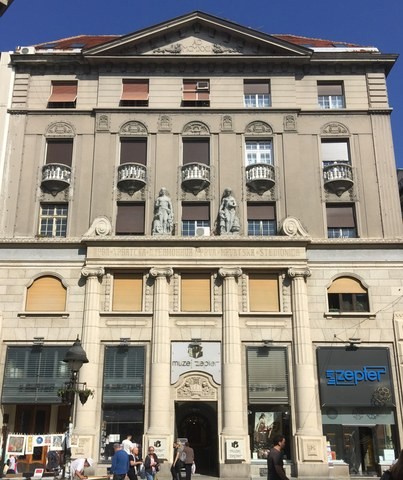
Zepter Museum
About the company:
Muzej Cepter is a private art museum in the heart of Belgrade, on 42 Knez Mihail pedestrian street. It opened on 1 July 2010 and became the first private art museum in Serbia registered by the Ministry of Culture. The founder of the museum is Madeleine Zepter, the co-founder is Zepterinvest. The purpose of the collection is to show the Serbian art of the second half of the XX century and the beginning of the current millennium in one space.
The museum occupies the building of the former First Croatian Savings Bank, designed by the architect Dionysus Andria Sunko. The house was built with a dual purpose: the ground and first floors were allotted to the bank, and apartments were located above. The building has three facades, the main one facing Knez Michael Street; it was designed in the spirit of the Berlin and Hungarian secession - a rare style for Belgrade. The building is classified as a cultural monument of the second category. The exposition is deployed on three levels - in the basement, on the first floor and upstairs.
The core of the collection is the works of artists and sculptors who were part of the groups Zadar, December, Eleven, Media, as well as representatives of the informant, new narrative and poetic figuration, pop art, transavant-garde and fantastic painting. In 2010-2013, the number of submitted authors increased from 134 to 164, and works – from 350 to more than 400. In the exposition you can see “Self-Portrait” by Zora Petrović (circa 1950), “The Wounded Heron” by Milo Milunovic (1965), “Uncle Joschka Kovac” by Milan Konjevic (1959), “In Honor of Atsa Tomašević” by Milos Baić (1978) and “One Last Day” by Stoyan Celic (1971).
The museum is open from Tuesday to Friday from 12:00 to 20:00, on Saturday and Sunday from 10:00 to 20:00; Monday is a day off. The ticket costs 200 dinars, for students and visitors over 65 - 100, on Sundays admission is free. The museum has a library, shop and cafe. Republic Square and Student Square can be reached on foot in a few minutes; city transport also stops nearby.
The museum is suitable for those who want to get an idea of Serbian art after the Second World War, and those who are interested in the architecture of Belgrade Art Nouveau and Secession. The small halls are convenient for a leisurely inspection, and the cafe and shop make the visit part of a walk along Knez Michael Street. The library and temporary exhibitions of modern authors are valuable for specialists.
Photograph: Boubloub, CC BY-SA 4.0 license, Wikimedia Commons - https://commons.wikimedia.org/wiki/File:Zepter Museum Facade.jpg
Photographs (1)