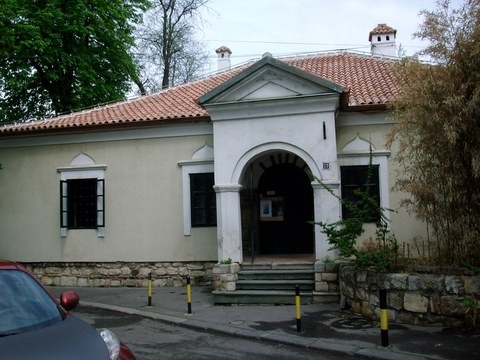
Museum of Theatre Arts of Serbia
About the company:
The Museum of Theatre Arts of Serbia (Muzej pozorišne umetnosti Srbije) is dedicated to the history of Serbian theatre - dramatic, opera, ballet and puppet. It is located in Belgrade, on 19 Gosdar-Evremovoi Street, a stone's throw from Republic Square and the Vuk and Dositej Museum. The museum collects everything that preserves the memory of the performance after the curtain fell: manuscripts, posters, photographs, sketches of scenery and costumes, recordings of rehearsals and premieres.
The idea to create such a museum was proposed by the writer and playwright Branislav Nusic back in 1901, when he headed the National Theatre. It was not until November 28, 1950 that the museum was established by the Ministry of Science and Culture. The first rooms were allocated to him in 1951 at the attic of the Museum of Applied Arts, and in September 1952 he moved to the house of merchant Miloje Bozic on Gosdar-Evremova. This house was built in 1836 over the basement of a demolished Turkish building. Božić was a trading partner of Prince Milos. In the 1920s, sculptor Toma Rosandich and artists George Jovanovic, Steva Bodnarov, Nikola Besevic, Evta Peric, Pierre Krijanich and Danica Antich lived and worked here, so the building was called the “House of Artists”. Before the opening of the museum, it was restored according to the project of architect Dragoslav Pavlovich.
The fund of the museum began to form in 1948, and since 1951 it has kept theatrical material covering the period from the XIII century. Collections are divided by types: archive and documents, letters, manuscripts of plays, posters and programs, photographs, audio and video recordings, visual and memorial items, sketches of set design and costumes, personal funds, library and newspaper archive. The exposition area is small – about 250 square meters, but digital collections number more than 65 thousand objects. Since 1974, the museum has published the magazine Theatron, and its library is open to researchers.
Visit is free. The gallery works on weekdays from 9:00 to 18:00, on Saturday - from 9:00 to 14:00 (only by appointment), Sunday - a day off. Researchers are engaged on weekdays from 10:00 to 14:00. From Republic Square and Student Square (Trg Studentski) you can walk in five to seven minutes; nearby stop trams and buses running through the center.
The museum will be interesting for those who love theater and want to look behind the scenes of history: there are thematic exhibitions about actors, directors and entire eras, lectures, meetings with theater figures and chamber performances. For theater students and researchers, it is also a working archive. And the Božić House itself is a rare surviving example of Belgrade residential architecture of the first half of the XIX century.
Photo: PedjaNbg, CC BY-SA 3.0, Wikimedia Commons - https://commons.wikimedia.org/wiki/File:%D0%9C%D1%83%D0%B7%D0%B5%D1%98 %D0%BF%D0%BE%D0%B7%D0%BE%D1%80% D0% B8% D1% 88% D0%BD%D0%B5 %D1%83%D D0%BC%D0%B5%D1%82% D0%BD%D0%BE%D1%81%D1%82%D0%B8.JPG
Photographs (1)