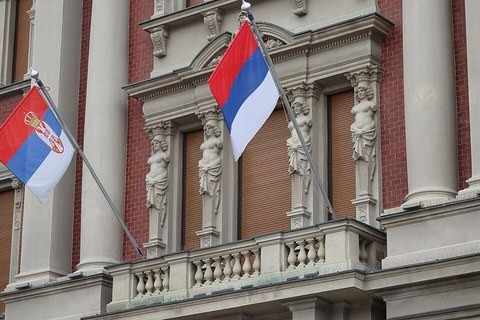
People's Museum of Serbia
About the company:
The People’s Museum of Serbia (Narodni muzej Srbije) stands on the Republic Square, the main square of Belgrade, in the quarter between Vashina, Chika Lubin and Laze Paču streets. This is the oldest and largest museum in the country: more than 400,000 objects that cover the path from the Stone Age and antiquity to Serbian modernism of the XX century. The logic of the exposition is simple: climbing the grand staircase, the visitor passes through the halls of archeology, the Middle Ages, and the art of modern times and enters the halls of national painting.
The museum was founded on May 10, 1844 by the decree of the Minister of Education Jovan Steria Popovic and was first called the Museum of Serbian. He did not have his own building for a long time: the collections roamed through rented houses, and in the First World War part of the collection was taken out and looted. The current house was built in 1902-1903 for the Board of Funds, Belgrade’s oldest financial institution, according to the project of architects Andra Stevanovic and Nikola Nestorovic in the spirit of neo-renaissance with neo-baroque domes. The museum moved here in 1950 and opened on May 23, 1952, and closed in 2003 for fifteen years of renovation; the doors reopened on June 28, 2018.
The main treasure is the Miroslav Gospel, an illuminated manuscript circa 1190 on 362 parchment sheets, included in the UNESCO Memory of the World register in 2005. Nearby is the golden sarcophagus and mummy of the Egyptian priest Nesmin, a numismatic collection of more than 300,000 coins, medals, rings and seals. A separate section consists of 1,100 works of Western European art: Claude Monet’s Rouen Cathedral, Pablo Picasso’s Head of a Woman, works by Renoir, Degas, Cezanne and Matisse, most of which come from the collection of Prince Paul. The Serbian line is represented by the “Coronation of Tsar Dusan” by Pai Jovanovic (1900), paintings by Nadezhda Petrović and Sava Shumanovic, sculptures by Ivan Meshtrović.
Address - Trg Republica, 1a; the nearest stops of trams and buses are called "Trg Republica". The museum is closed on Mondays, on other days it is open from 10:00 to 18:00, and on Thursdays and Saturdays - from 12:00 to 20:00. A ticket for the permanent exhibition costs 300 dinars, on Sundays admission is free; for 600 dinars you can also visit the thematic exhibition. Nearby there is the National Theatre, Kneza Mikhaila Street, Kalemegdan Fortress and the Ethnographic Museum, so the visit is easy to fit into a walk in the center.
The museum is worth choosing if you want to understand what Serbian culture is made of at one time, and not collect it in pieces in different halls. It is worth laying two or three hours for the inspection; with children it makes sense to go to the mummy and the Gospel, with lovers of painting to the French. Those who are looking only for contemporary art, it is better to immediately go to the Museum of Modern Art in Ushce.
Photograph: Alexander Sigachev, CC0 license, Wikimedia Commons - https://commons.wikimedia.org/wiki/File:Beograd - National Museum of Serbia - 2025-03 - p10.jpg
Photographs (1)