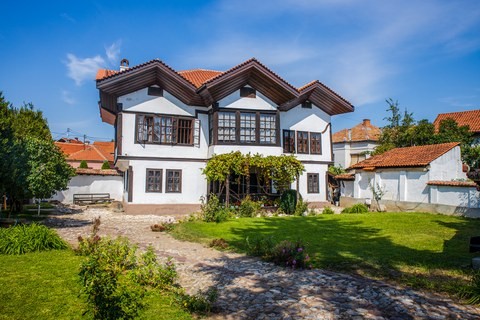
Ponyshavy Museum
Nicola Pashy Street 49, 18300 Pirot
About the company:
The Ponišavlja Museum is the main museum of the city of Pirot in southeastern Serbia, dedicated to the material and spiritual culture of Middle and Upper Ponišavje and the Lužnica region. He occupies the family house of the Christichs – “Old Pile” (Stara Kuma), known as Konak Mali Rista, at 49 Nikole Pašića Street, in the Tiyabara quarter.
The house was built in 1848 for the well-to-do merchant Christa Jovanovitch, nicknamed Mali Rista (Little Rista), or Chuchuk Rista; a tablet on the ground floor says that construction was completed on April 5, 1848. Due to the size and number of storeys of the house, the merchant needed permission from the Turkish authorities, so the building was put on the outskirts of the city. Christ Jovanovitch traded throughout the Ottoman Empire, and his descendants carried the surname Christich. Since 1953, the house belongs to the Serbian state, in 1979 it was declared a cultural monument of exceptional importance (number SK 295), and the museum opened to the public on November 29, 1956. In the interiors, films “Zon Zamfirov” and “Ivkova Glory” were shot.
At the heart of the house is a symmetrical, almost square building with a hall in the shape of a cross; the hearth and konak occupy the central place, the men's divanhana room and the women's room are separately allocated. The roof is crowned by an unusual solution with the design of the observation deck, and the best carved cabinet-dolap on the first floor is attributed to the masters of the famous debar school. The permanent exhibition “The Old Serbian Pirot Pile of the XIX Century” recreates the life of a rich merchant family. Among the exhibits are tools made of deer horn and stone of the Neolithic era (Starchev culture, 5500-4,900 BC) from the locality of Gorne-Pole near Crnoclisht, a ceramic ascos for sauces from the Begov Bridge near Stanichenia, a bronze Corinthian statuette of a warrior from Vranisht (700-600 BC). The historical collection includes a Russian guards sword, a curved Turkish saber and a yatagan; a separate pride of the museum is a collection of Easter eggs, about 200 pieces, the oldest of which ("chuvarkucha") dates back to 1917.
The museum is open from Tuesday to Sunday from 10:00 to 18:00. Pirot is connected to Belgrade and Niš by road and railway. In the entourage of the old Pirot bazaar at the museum there is a gallery where the works of local artists are shown. Nearby is the city center with its charmia and famous pyrot carpets.
The museum is suitable for those interested in ethnography, traditional architecture and the history of the Ottoman period in the Balkans, as well as families: the place is beautiful and not overloaded with exhibits.
Photograph: Dkov92, CC BY-SA 4.0 license, Wikimedia Commons - https://commons.wikimedia.org/wiki/File:Muzej Poni%C5%A1avlja, Pirot 17 09 2024.jpg
Photographs (1)