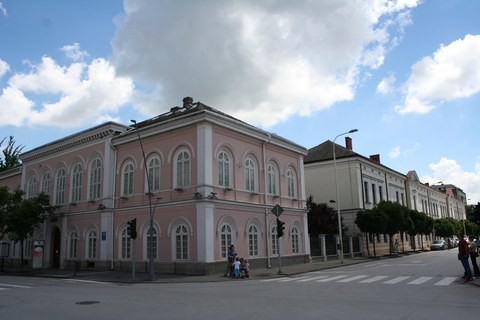
Shabatza People's Museum
About the company:
Shabats People's Museum (Narodni Shabats Museum) occupies house No. 13 on Masarykova Street - the former building of the Shabatsk semi-gymnasium, built in 1857 and recognized as a cultural monument of great importance. Shabats stands on Sava, in Machva, and its history of the XX century is dramatic: in the First World War, the city was almost completely destroyed, so the surviving school building itself became an exhibit.
Collect antiquities here began in the late XIX century at the gymnasium. On June 20, 1934, the board of the Shabatsk People’s Library and Reading House decided to establish a museum; it was given the premises of the former Mira-Mara Kafana on the same Masarykova Street. After the war, on January 11, 1955, the museum was revived as a separate institution - the City Museum, and in 1960, the building of the gymnasium was transferred to it, where it still works.
For the permanent exhibition, the museum has issued a separate guide. Today, there are about 121,000 items in the funds, distributed in fifteen collections: archaeology, history, ethnology, art, numismatics. The most famous exhibit is the statue of the god Mercury of the III century. Nearby are the chakshira voivodes Stojan Chupić, a participant in the First Serbian Uprising, the libade (parade clothes) Tomania Obrenović, an embroidered towel-tekerish of the First World War and the typewriter of the playwright Dusan Kovacevic, a native of Šabac. A separate permanent exhibition is dedicated to the Battle of Mishar in 1806, when Karadjordje rebels defeated the Ottoman army; it is located in the village of Mishar, outside the city. Another site of the institution is the Museum of Shabatsky Jews.
The main building is open on weekdays from 8:00 to 19:00, on Saturday - from 10:00 to 14:00. Tickets for adults cost 150 dinars, for schoolchildren, students and pensioners - 100; every last Thursday of the month admission is free. A visit to Michar and the Museum of Shabatsky Jews must be agreed in advance by phone +381 15 350 287. From Belgrade, the bus goes about an hour and a half, the museum is a stone's throw from the central square.
The museum is good for those who travel along Machva and want to understand the region through things: there is Roman bronze, peasant costume, and urban life of the XIX century. Children should come to the exhibition about Michar, adults - for ethnographic collections and portraits.
Photo: Vanilica, CC BY-SA 4.0 license, Wikimedia Commons - https://commons.wikimedia.org/wiki/File:%C5%A0abac, Zgrada Narodnog muzeja (zgrada polugimnazije) 003.jpg
Photographs (1)