
Pechori is a city in the Russian Federation, the district center of the Pskov region; located 52 km west of Pskov, 3 km from the Pechori-Pskovski railway station (border station on the border with Estonia). The population is 13.6 thousand inhabitants (2001). Former Posad of the Pskov-Pechora Monastery (founded in 1473). The monastery is located in a basin with karst caves. In 1920-1945, the Pechoras were part of Estonia.
History
The monastery was founded by the priest John of Yuriev (now Tartu). The name of the spiritual leader of the first ascetics is preserved - Mark. The name of St. Mark is headed by the Cathedral of Pskov-Pechora Saints. Beginning with the wife of John of Yuriev, Vassa, for centuries the coffins with the bodies of monks, as well as fallen soldiers and just residents of Pehor Posad are not interred in the earth, but are made in crypts on each other. In the monastery cave necropolis, the crypts are filled to the very vaults with blackened coffins, while there are no signs of smoldering of the dead bodies. There are six long underground galleries in the caves. Among those buried here are representatives of the Russian families of the Pushkins, Nazimovs, Buturlins, relatives of M. I. Kutuzov, poet A. N. Pleshcheev, composer M. P. Mussorgsky lie here.
John’s successor, Hieromonk Misail, placed on the mountain itself the wooden church of Antony and Theodosius of Kiev-Pechora, where the cells of the inhabitants were cut down. Soon, however, the monastery on the mountain (the so-called Old) was burned by the knights of the Livonian Order. In the 1520s, under the abbot Dorotheus, the monastery was moved to the foot of the mountain, the Assumption Church was expanded, a cave church was built in the name of Anthony and Theodosius, a church was built in the name of the Forty Sebasti martyrs, and the construction of a monastery belfry was begun. The help of the monastery was provided by the sovereign deacon Misyur Munekhin, a man of remarkable education and piety, who appreciated the strategic importance of Pechora. Misur Munekhin gave patronage and abbot of the monastery Cornelius, under which the monastery flourished: the number of monks significantly increased, icon painting, carpentry, ceramic workshops worked, a library was collected. The Third Pskov Chronicle was conducted here, from the so-called Pechora collections the correspondence of Prince Andrei Kurbsky with John IV became known.
Abbot Cornelius began the spiritual enlightenment of the fugi (Ests), he founded temples in the south of Estonia, and appointed priests there. Under Cornelius, on the orders of Ivan the Terrible, a powerful stone wall was built around the monastery with nine towers and three gates, and a stone Annunciation Church was built in the monastery and, for the Strelets garrison, which constantly served in the fortress, the St. Nicholas Gate Church, connected with the battle tower.
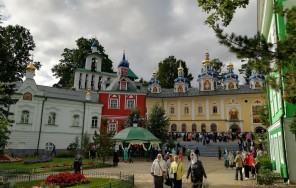
Pskov-Pechora Monastery
The walls of the Pechora fortress go along the slope of a deep ravine, skirting the hollow, at the bottom of which the Kamenets stream flows. The total length of the walls is 726 meters, their thickness is 2 meters. The current fortress consists of 9 towers. The monastery withstood sieges of the army of Stefan Batory (in the Livonian War), the Polish Hetman Hodkiewicz (in the Time of Troubles), the Swedish kings Carl X Gustav and Charles XII. After the Northern War, when the western borders of Russia moved away, the monastery lost its defensive importance.
There are three revered shrines in the monastery: the miraculous icons of the Mother of God - the Assumption, which is brought by the procession of the cross every year on the feast of the saint, Emotions and Oligitria. The image of the Assumption is stored in the cave Dormition temple, and the Emotions and Odigitria - in the Mikhailovsky Cathedral. To store gifts and contributions to the monastery at the end of the 17th century, a stone sacristy was built, where the monastery library is now located. In the 18th century, the mountain was lined with the facade of the Assumption Church, built in the Baroque style. Crowned with multi-tiered domes, painted with frescoes, it is only a wall: the church itself is in the mountain.
On the lower site of the monastery are the hospital church of St. Lazarus, the church of Cretnia, the Brotherly building and a two-storey refectory. On the upper platform there are monumental porticoes and a golden dome of the temple of Michael the Archangel, built in 1827 with the money of officers and soldiers, participants in the war of 1812. Behind the domes of the Assumption Church on the mountain, among the monastery garden, there is a wooden church of Pskov-Pechora saints, distinguished by elegance and simplicity. The monastery has 11 churches, three of which are cave churches. In the 1960s, great elders, guardians of the spirit of the old Valaam, who did not agree with the introduction of a new calendar style in the Finnish Orthodox Church came here from the Novovalaam monastery in Finland. Among the personalities of that time should be noted abbot Alipia (Voronov) - icon painter, writer, participant of the Great Patriotic War. Worked a lot in Pechora expert icon, icon painter Archimandrite Zinon.
In the Pechora district there is a museum of the Seto people in the village of Sigovo. The museum is located in a large barn of a peasant estate. Seto is an ethnographic group of Estonians. For more than five hundred years they settled in the south-east of Estonia and on the Pechora land. Having adopted Orthodoxy, Seto prayed with the Russians in the same churches, celebrated church holidays together, but this did not prevent them from preserving their ancient pagan traditions, honoring the god Peko, bringing him gifts, believing in amulets. Seto led a subsistence economy and lived separately.


 Radmilla Kovaleva


 Guide license
 Guide license
 Guide license
 Guide license
 Guide license
 Guide license