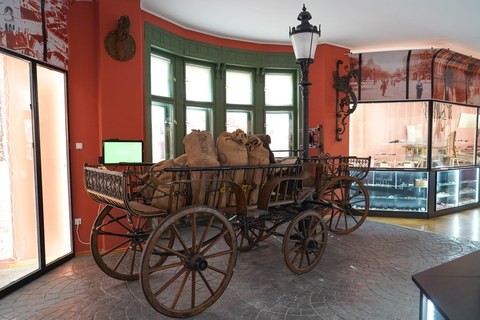
Subotica City Museum
About the company:
The Subotica City Museum (Gradski Subotica Museum, Hungarian Szabadkai Városi Múzeum) occupies the house of Miksha Demeter in Synagogue Square (Trg Synagogue), 3 - a stone's throw from the famous synagogue and seven minutes from the town hall. This is the local history museum of Northern Bačka: archaeology, ethnography, history, art and nature, gathered together.
The museum traces its lineage to the Society of the Subotitsa Public Library and Museum, founded in 1892; the first collections were started by the gymnasium teachers Imre Balash and Istvan Ivanyi in the 1870s. After a long break, the institution was revived in 1948, and since 2008 it has been working in the former profitable house of doctor Miksha Demeter. Before moving, the collection huddled in the Reichle Chamber, one of the most beautiful buildings in the city. The current house was built in 1906 by Budapest architects Jozsef and Laszlo Vago in the style of the Darmstadt secession: asymmetric bay windows, medallions with birds, forged railings. At the bottom there were two shops and a printing house, next to the owner's five-room apartment with a doctor's office, at the top - two more rented apartments.
The fund is divided into archaeological, ethnographic, historical, artistic and natural history collections. Among the notable things are the Tibetan prayer mill, brought by the traveler Oscar Voynich from Asia, the sword of Serbian kings, the anniversary album of the writer’s father Dejo Kostolani, glass negatives of the aviator and photographer Ivan Sarich. In the souvenir shop of the museum in the building of the town hall, the interior of the pharmacy “At the Mother-Patron” (Mayake’s Code) of 1813 is recreated, and the attic has an exhibition “Nature and Man” with stuffed animals and hunting trophies, including about a hundred exotic ones.
The museum takes from Tuesday to Saturday from 10:00 to 18:00; Sunday and Monday are weekends. The ticket costs 200 dinars, for groups of ten people - 150; pensioners, preschoolers and people with disabilities are free. From the main square and the town hall go seven minutes, the landmark is the synagogue. For a fee, the museum organizes excursions to the Great Hall and the observation deck of the town hall – they begin at noon.
The museum is small and well-organized for the first acquaintance with the city: in an hour and a half, a portrait of a multilingual Subotica is formed here - Hungarian, Serbian, Bunevack. It is suitable for families with children, lovers of secession and those who are tired of large metropolitan meetings. If time permits, it is worth combining a visit with a visit to the synagogue next door and a walk along the corzo.
Photograph: DjordjeMarkovic, CC BY-SA 4.0 license, Wikimedia Commons - https://commons.wikimedia.org/wiki/File:Gradski muzej Subotica - stara zapre%C5%BEna kola, etnografska postavka.jpg
Photographs (1)